
China's Intelligent Driving Insurance Moves from Concept to Commercial Implementation
China is taking another step towards the commercialization of intelligent driving. As advanced driver assistance systems become standard across new passenger vehicles and higher levels of autonomous driving enter the market, regulators and industry participants are increasingly focused on one challenge: determining liability when intelligent driving systems are involved in accidents.
A recent pilot initiative in Beijing addresses this issue by combining commercial insurance with trusted automotive data infrastructure. The initiative reflects a broader shift towards establishing technical and institutional frameworks that can support the next phase of intelligent connected vehicle deployment.
Read more about earlier developments in autonomous driving.
Executive Summary
Beijing has launched China’s first commercial insurance pilot covering intelligent connected new energy vehicles from L2 to L4 automation.
Trusted data spaces are positioned as the core infrastructure for accident analysis and insurance claims.
The solution enables secure data sharing while keeping vehicle data under the control of the original owner.
Standardized accident analysis aims to improve claims efficiency, reduce liability disputes, and support insurance product development.
Pilot deployments have already been completed across multiple vehicle manufacturers and production models.
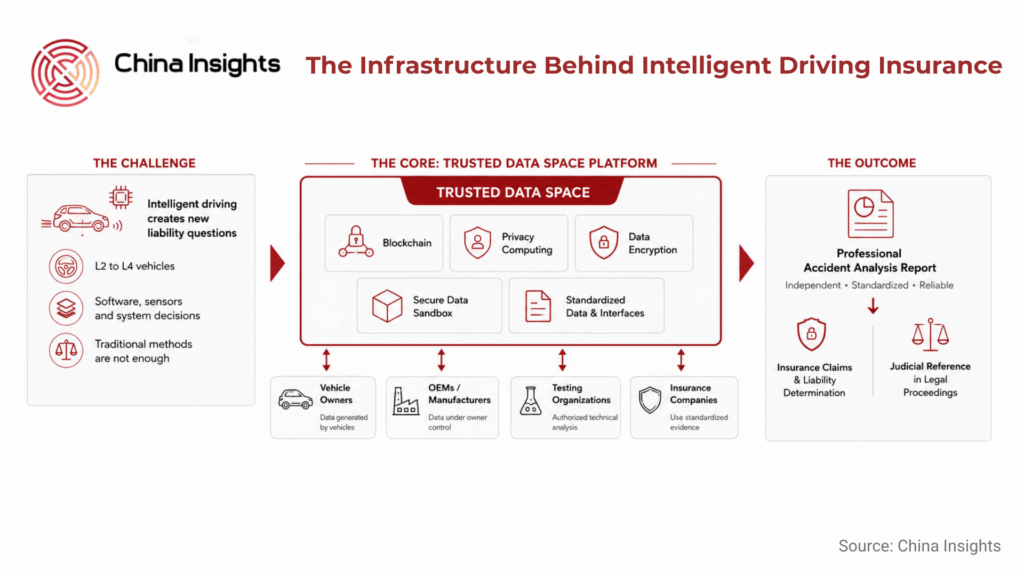
Beijing Launches Intelligent Driving Insurance Pilot
At the 2026 Zhongguancun Forum Annual Meeting, the Beijing Financial Regulatory Bureau announced the launch of the development and application of commercial insurance for intelligent connected new energy vehicles. The initiative upgrades existing new energy vehicle insurance products to support intelligent connected vehicles ranging from Level 2 (L2) to Level 4 (L4) automation.
The announcement represents one of the first market-oriented efforts in China to build insurance products specifically designed for intelligent driving scenarios. As vehicle automation increases, traditional insurance models require new methods for determining accident causes and allocating liability.
Intelligent Driving Creates New Insurance Challenges
More than 60% of new passenger vehicles sold in China include combined driver assistance functions at the L2 level by 2025. Intelligent driving functions are rapidly moving from optional features to standard equipment.
This transition changes the nature of road accidents. Traditional accident investigation methods are often insufficient because they rely primarily on physical evidence and witness statements. Intelligent driving introduces additional layers of vehicle software, sensor data and system decision-making that require specialized technical analysis. As commercial deployment expands, accident investigations must provide reliable technical evidence that can support insurance claims while meeting compliance requirements.
Trusted Data Spaces Form the Technical Foundation
The proposed solution is built around the Trusted Data Space for the Intelligent Connected New Energy Vehicle Industry, an initiative jointly led by the China Association of Automobile Manufacturers (CAAM).
Rather than transferring large amounts of sensitive vehicle data between organizations, the trusted data space enables secure collaboration using technologies including blockchain, privacy computing, data encryption, and secure data sandboxing.
The platform also seeks to establish standardized data formats, technical interfaces, and operational procedures across participating organizations, reducing integration costs while improving interoperability.
A Standardized Accident Analysis Process
The proposed service model creates a complete digital workflow covering accident investigation, responsibility analysis, and insurance claims.
Vehicle data relevant to an accident is securely stored and verified through the trusted data space. Once an incident occurs, standardized verification procedures confirm the authenticity and completeness of the available data before technical analysis begins.
Authorized third-party testing organizations then perform accident analysis using verified data and applicable technical standards. Privacy computing technologies enable multiple data sources to be analyzed without exposing confidential information.
The results are compiled into professional accident analysis reports that can be accessed by insurance companies and judicial authorities as technical reference material during claims handling or legal proceedings.
This standardized workflow is intended to improve consistency while reducing disputes over data credibility and accident responsibility.
Benefits Across the Automotive Ecosystem
For vehicle owners, independent technical analysis may provide more transparent accident investigations and shorten insurance claim processing times.
Vehicle manufacturers benefit from an independent accident assessment process that reduces concerns over manufacturers evaluating their own systems. Since data remains within each organization’s own domain, manufacturers can also protect commercially sensitive information while participating in cross-industry collaboration.
Insurance companies gain access to standardized technical evidence for liability determination. Over time, accumulated accident data could also support the development of new insurance products and more accurate risk pricing for intelligent driving vehicles.
At the industry level, the trusted data space provides a practical mechanism for implementing technical standards and improving collaboration between automotive manufacturers, testing institutions, insurers, and judicial authorities.
What this means for business
The Beijing pilot signals that China is beginning to build the institutional infrastructure needed for large-scale intelligent driving deployment. While vehicle technology continues to advance, regulators and industry organizations are increasingly focused on creating standardized mechanisms for accident analysis, liability determination, and insurance claims.
For automotive manufacturers, the initiative highlights the growing importance of data governance and interoperability alongside vehicle development. Insurance companies may gain new opportunities to develop intelligent driving insurance products supported by standardized technical evidence. Technology providers involved in privacy computing, blockchain, and secure data collaboration may also benefit as trusted data infrastructure becomes more widely adopted.
Although currently implemented as a pilot, the approach demonstrates how China is addressing one of the key barriers to intelligent driving commercialization: establishing trusted, standardized, and efficient processes for determining responsibility when intelligent driving systems are involved in traffic accidents.
Source
http://www.caam.org.cn/chn/8/cate_80/con_5237061.html
Author
Dr. Richard van Ostende

Related Articles