
China Tightens Market Entry and Compliance Rules for Public Air Transport Operators
In June, the Ministry of Transport (MOT) released an official interpretation of the revised Regulations on the Operating License of Public Air Transport Enterprises .The regulations effective July 1, 2026, significantly update the licensing framework governing civil aviation carriers in China.
The revised framework marks a clear shift toward tighter, lifecycle-based supervision of China’s airline sector, raising entry thresholds and embedding continuous compliance obligations that extend well beyond initial licensing approval. For international and foreign-linked aviation businesses, it reinforces a constrained role within China’s aviation market, where participation is largely indirect and governed by stricter oversight of partnerships, financing structures, and ecosystem services rather than operational control of airlines.
Executive Summary
The revised regulations tighten entry conditions for public air transport enterprises, particularly on capital adequacy, governance quality, and integrity requirements.
Licensing procedures remain centralized under the CAAC, with a statutory decision period of up to six months.
Continuous compliance is emphasized, with stricter reporting obligations on corporate governance changes, financial risks, and operational disruptions.
The regulatory framework introduces stronger supervisory discretion, including suspension of expansion rights for underperforming operators.
Enforcement mechanisms are strengthened, with higher fines and clearer license revocation conditions for non-compliance.
The regime signals a shift toward risk-based, lifecycle supervision of airline operators rather than one-time entry approval.
Regulatory Context and Policy Drivers
The updated legal framework modifies licensing conditions, procedural requirements, and administrative responsibilities for unlicensed operations. It also reflects a broader policy objective to modernize China’s civil aviation governance system, strengthen safety oversight, and improve market order.
Within this structure, the CAAC remains the central regulatory authority responsible for issuing and supervising operating licenses, while regional civil aviation administrations support enforcement and ongoing monitoring.
Strengthened Entry Conditions for Market Access
The revised regulations clarify market entry requirements for public air transport enterprises. Applicants must now meet stricter criteria across legal structure, financial capacity, and governance quality.
Key conditions include incorporation as a domestic legal entity with a Chinese legal representative, minimum registered capital thresholds (RMB 600 million for passenger operations and RMB 400 million for cargo operations), and demonstrated operational readiness in terms of aircraft and qualified aviation personnel.
In addition, controlling shareholders and actual controllers must demonstrate sound financial status and a clean integrity record, with no major violations in the preceding three years. Senior management competence is explicitly emphasized as part of licensing eligibility.
Licensing Procedure and Administrative Oversight
The regulations maintain a centralized licensing model under the CAAC. Once an application is accepted, the authority is required to consult relevant regional civil aviation administrations before issuing a decision.
A statutory decision timeline of up to six months is established, introducing procedural predictability but also reinforcing administrative discretion. Applicants are also granted procedural rights, including the ability to request hearings before licensing decisions are finalized.
Where a license is granted, issuance must occur within 10 working days. Where denied, authorities must provide written justification and inform applicants of their rights to administrative review or litigation. This structure reflects a dual objective: procedural standardization and enhanced administrative control over market entry.
License Changes and Operational Flexibility Controls
The revised framework expands regulatory oversight over post-licensing changes, particularly corporate restructuring and operational adjustments.
Enterprises must submit formal applications for changes to company name, main operating airport, or business scope. In cases involving changes to the main base airport, both the original and destination regional civil aviation authorities must provide input, increasing regulatory coordination requirements.
Importantly, the CAAC is granted discretionary authority to restrict or suspend expansion applications for airlines that demonstrate weak operational efficiency, non-compliance with flight management requirements, or insufficient safety capability.
This introduces a performance-based regulatory mechanism affecting growth potential even after market entry.
Continuous Reporting and Compliance Obligations
A major feature of the revised regulations is the shift toward continuous supervision through structured reporting obligations. Enterprises must report significant corporate changes within 10 working days, including major management changes (over one-third of senior management), operational suspensions, bankruptcy filings, or changes in controlling shareholders. License revocation or closure events must be reported within 30 days.
Annual reporting requirements are also formalized, with submission deadlines set at April 30 each year. Reports must include operational, financial, governance, and personnel information, accompanied by audited financial statements.
This framework establishes a lifecycle compliance model, ensuring ongoing regulatory visibility into airline operations beyond initial licensing approval.
Market and Industry Implications
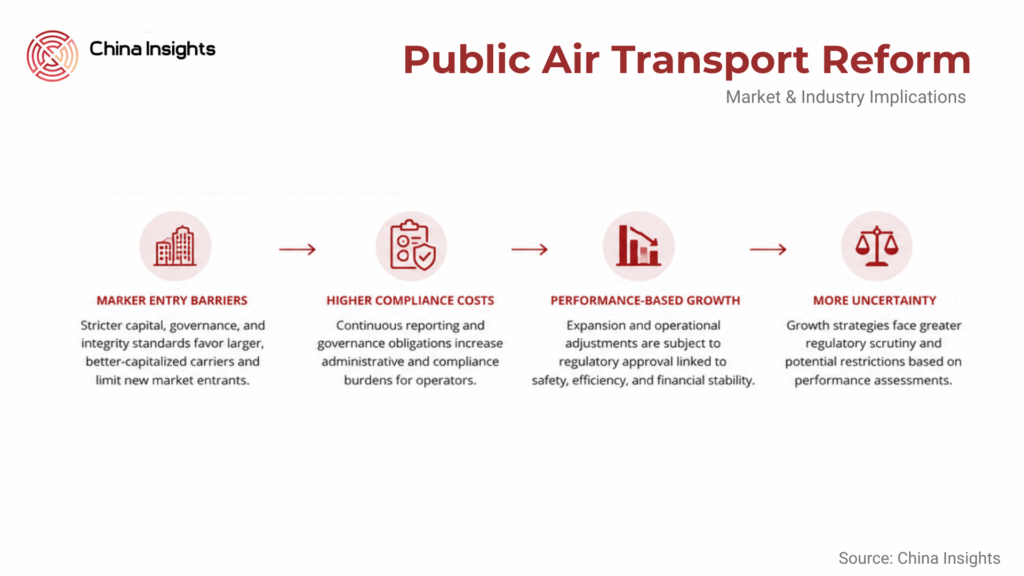
The revised regulatory framework is likely to reshape competitive dynamics in China’s civil aviation sector. Higher entry thresholds will favor larger, better-capitalized carriers and may constrain the emergence of smaller operators.
Simultaneously, continuous compliance requirements increase administrative and governance costs for existing airlines. The emphasis on operational efficiency, safety capability, and financial resilience suggests stronger alignment between regulatory status and operational performance.
The framework also introduces greater uncertainty for expansion strategies, as regulatory approval is now explicitly linked to performance indicators and risk assessments.
What this means for business
The revised licensing regime reinforces that China’s public air transport sector remains closed to foreign airline operators, with operating licenses restricted to Chinese legal entities. Foreign companies therefore participate primarily through adjacent segments such as aircraft leasing, MRO, airport services, aviation IT, and commercial partnerships.
The key change is tighter regulatory oversight rather than market opening. As CAAC expands lifecycle supervision and compliance requirements, indirect participants face greater regulatory risk, with expansion increasingly tied to the Chinese operator’s compliance and financial performance.
For international companies, regulatory alignment and compliance are becoming strategic business requirements rather than administrative considerations.
Sources
https://www.mot.gov.cn/gongkai/zcjd/202606/t20260611_4207338.html
https://xxgk.mot.gov.cn/jigou/fgs/202606/t20260611_4207337.html
Author
Dr. Richard van Ostende

Related Articles