
China Issues New-Type Energy System Plan (2026–2030): Structure, Priorities, and System Transformation
On 25 June 2026, the “New-Type Energy System Construction 15th Five-Year Plan” (《新型能源体系建设“十五五”规划》) was jointly issued by the National Development and Reform Commission (NDRC) and the National Energy Administration (NEA). The plan defines China’s energy system development framework through 2030.
The policy sets a transition pathway toward a clean, low-carbon, secure, and efficient energy system, with structural targets for energy supply, consumption, infrastructure, and system governance.
Executive Summary
- China has issued a national plan for building a new-type energy system for 2026–2030.
- By 2030, a clean, low-carbon, secure, and efficient energy system is targeted.
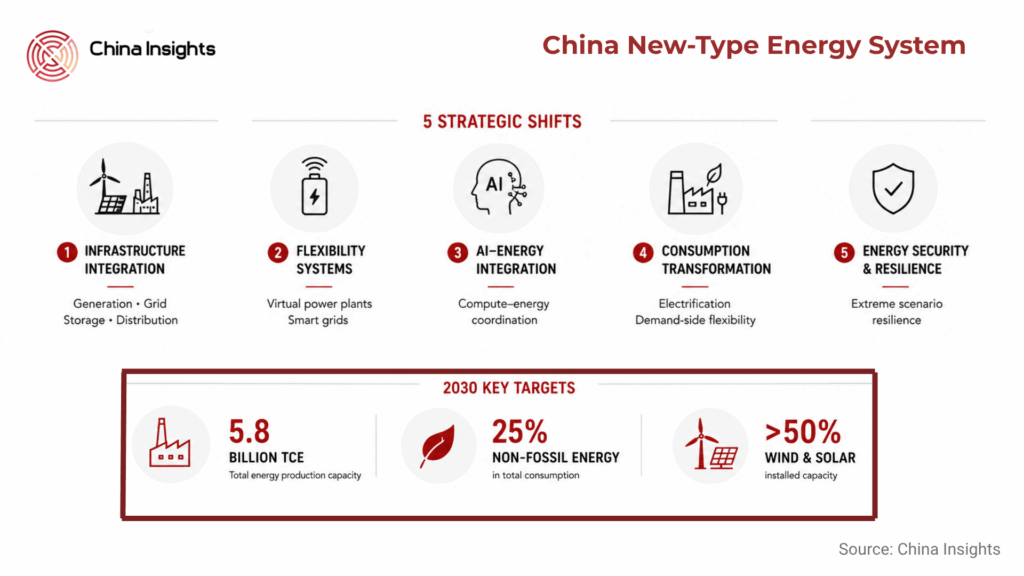
- Energy production capacity is set to reach 5.8 billion tons of standard coal equivalent.
- Non-fossil energy is expected to account for 25% of total consumption.
- Wind and solar will exceed 50% of installed capacity and become the dominant power source.
- Power system flexibility will be expanded through virtual power plants and smart grids.
- AI-energy integration and “compute-energy coordination” are identified as strategic priorities.
- Energy security and extreme scenario resilience are embedded in system design.
Policy Framing: Energy System as a Strategic Infrastructure Platform
The plan positions the energy system as a foundational national infrastructure platform rather than a sectoral utility system. Energy is increasingly linked to industrial competitiveness, technological capability, and national security. The policy emphasizes both supply security and structural transformation, reflecting a dual-track approach.
This includes maintaining stable fossil energy capacity while rapidly scaling non-fossil energy systems.
Core Targets: Supply Capacity and Energy Structure Transition
The plan sets a binding target for total energy production capacity at 5.8 billion tons of standard coal equivalent. At the same time, it establishes clear structural transition goals for energy consumption.
Non-fossil energy is targeted to reach 25% of total consumption, marking a continued shift away from fossil fuels. Wind and solar are expected to exceed 50% of installed power capacity, becoming the dominant generation source.
This indicates a transition from fossil-based system dominance to renewable-led capacity expansion.
Energy Security and System Resilience
Energy security is a central pillar of the plan. The policy explicitly includes provisions for extreme scenario resilience, including supply disruptions and demand shocks. This reflects a risk-based approach to energy system design. The emphasis is on ensuring stable supply under both normal and stress conditions. Energy security is framed as a structural requirement rather than a short-term policy objective.
Infrastructure System: Integrated and Nationally Coordinated
The plan calls for the development of an advanced and adaptive energy infrastructure system. This includes coordinated development of generation, transmission, storage, and distribution networks. The spatial layout follows a “national integrated system” approach. Energy production bases, consumption centers, and transmission corridors are to be more tightly aligned. This reduces regional mismatch between resource availability and demand centers.
Energy Consumption System Transformation
A key focus is the transformation of energy consumption patterns. The policy promotes electrification and efficiency improvements across industrial and end-use sectors. Energy consumption is increasingly linked to digitalization, automation, and industrial upgrading. Demand-side flexibility is positioned as a core system feature. This reflects a shift from passive consumption to active demand management.
Flexibility Resources: Virtual Power Plants and Smart Systems
The plan places strong emphasis on flexibility resources in the energy system. Key technologies include virtual power plants, smart microgrids, and green electricity direct supply systems. These tools enable better integration of variable renewable energy into the grid. They also support demand-side participation in system balancing. Flexibility is treated as a structural requirement for high-renewable energy systems.
AI–Energy Integration and Compute-Energy Coordination
A significant emerging theme is the integration of artificial intelligence and energy systems. AI is increasingly used in generation optimization, grid management, and consumption forecasting. At the same time, data centers and computing infrastructure are becoming major energy consumers. The policy emphasizes “compute-energy coordination,” linking digital infrastructure development with energy system planning. This reflects the convergence of digital infrastructure and physical energy systems.
Spatial Planning and Resource Allocation
The plan emphasizes coordinated spatial planning of energy systems. This includes alignment between energy production bases, industrial centers, and consumption hubs. Non-fossil energy is expected to develop across five major growth regions and fossil fuel production bases are to be optimized rather than fully replaced. Energy import diversification is also part of the spatial strategy, which reduces dependency risks and improves system resilience.
Energy Technology and Innovation System
The plan highlights the importance of energy technology self-reliance. Core areas include renewable generation technologies, storage systems, smart grid technologies, and digital energy platforms. Innovation is positioned as a driver of both security and efficiency improvements, which aligns energy development with broader industrial innovation strategies. Technological capability is treated as a strategic energy security factor.
Governance and Market System Evolution
The energy governance system is expected to become more coordinated and efficient. This includes improved regulatory frameworks and better integration of market mechanisms. The policy supports coordinated planning across central and regional levels. Market-based mechanisms are expected to support resource allocation efficiency. This reflects gradual institutional reform within the energy sector.
What this means for business
The new energy system plan creates multi-layered opportunities across infrastructure, technology, and industrial supply chains.
- Renewable energy developers will benefit from large-scale capacity expansion targets.
- Grid and transmission equipment providers will see sustained infrastructure demand.
- Energy storage and flexibility solution providers will become system-critical players.
- AI and digital infrastructure firms will expand into energy system applications.
- Industrial users will face increasing pressure to electrify and decarbonize operations.
- Engineering and EPC firms will benefit from integrated infrastructure development.
- Energy technology companies will find opportunities in grid intelligence and system optimization.
Source
https://www.gov.cn/zhengce/202606/content_7073472.htm
Author
Dr. Richard van Ostende

Related Articles