
China Approves National Health Plan under the 15th Five-Year Framework: System Integration and Health Industry Expansion
On 29 June 2026, China’s State Council of the People’s Republic of China, as reported by Xinhua News Agency, reviewed and approved the “National Health Plan under the 15th Five-Year Framework”. The plan sets strategic priorities for China’s health system development and health industry expansion over the coming planning cycle. The policy reflects continued upgrading of China’s healthcare system, alongside a shift toward integrated service delivery, prevention-focused care, and structured development of the health economy.
Executive Summary
- The State Council approved the National Health Plan for the 15th Five-Year period.
- China’s health system is positioned for further integration across medical, insurance, and prevention systems.
- A life-cycle health service model is prioritized, covering prevention, treatment, and long-term care.
- Coordination between healthcare delivery, medical insurance, and disease control systems is strengthened.
- The health industry is identified as a strategic growth sector with new service models.
- Policy supports expansion of health products, services, and quality regulation systems.
- The plan builds on China’s existing large-scale healthcare infrastructure and rising life expectancy.
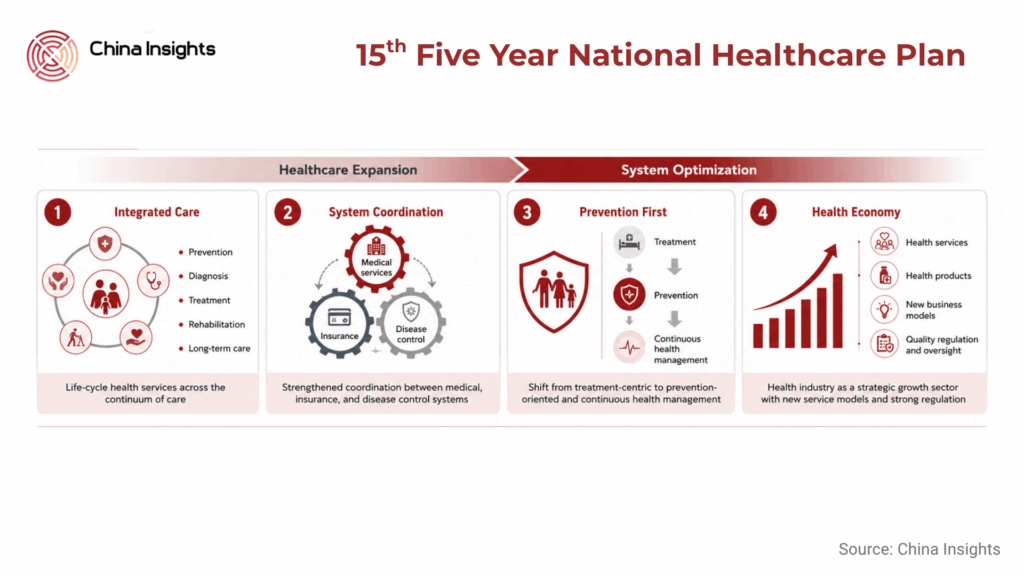
Policy Context: Health System Maturity and Structural Upgrade
China’s health policy enters a new phase characterized by system consolidation and quality upgrading. The approval of the national health plan reflects a transition from infrastructure expansion to system optimization. The government notes that China has built the world’s largest healthcare, disease prevention, and medical insurance systems. Life expectancy has reached 79.25 years, and key health indicators remain above average for upper-middle-income economies. The policy focus is shifting toward improving efficiency, integration, and service quality within this established system.
Integrated Health System Design
A central direction of the plan is the construction of an integrated health service system spanning the full life cycle. This includes prevention, diagnosis, treatment, rehabilitation, and long-term care. The objective is to move away from fragmented service delivery toward continuous and coordinated care pathways. The policy emphasizes stronger coordination between medical institutions, insurance systems, and disease prevention agencies. This integrated structure is intended to improve system efficiency and patient outcomes. The approach reflects increasing complexity in healthcare demand, driven by demographic change and evolving disease profiles.
Resource Coordination and System Efficiency
A key focus is the optimization of resource allocation across the health system. The plan calls for improved distribution of medical resources across regions and service levels. Coordination between healthcare providers, insurers, and public health institutions is positioned as a core mechanism for reducing inefficiencies. The objective is to ensure more balanced access to healthcare services while improving system responsiveness. This reflects a shift toward system-level governance of healthcare delivery rather than institution-based management.
Health Industry Development as a Growth Sector
The plan explicitly identifies the health industry as a strategic area for economic development. Policy direction supports the expansion of health-related services, products, and new business models. This includes both traditional healthcare services and emerging health-oriented service sectors. The emphasis is on fostering new service formats while improving supply quality and regulatory oversight. The health industry is increasingly positioned as part of China’s broader service sector expansion strategy.
Regulatory Framework and Quality Assurance
As the health sector expands, the policy places strong emphasis on regulatory oversight and quality control. The plan highlights the need to ensure safety and reliability in health products and services. This includes strengthening supervision systems and improving compliance mechanisms. The objective is to balance market expansion with risk control, particularly in new health-related service areas. This reflects growing attention to consumer protection and system integrity in a rapidly expanding sector.
Demand Drivers: Demographics and Disease Structure Change
The policy context reflects structural changes in China’s population and health demand patterns. Experts cited in the policy commentary note that shifts in disease profiles are creating new challenges for the healthcare system. Chronic conditions and aging-related health issues are becoming more prominent. This is increasing demand for long-term care, preventive services, and integrated health management solutions. The policy responds by prioritizing system adaptability and expanded service coverage across different population groups.
Linking Public Health and Economic Policy
The health plan is not framed solely as a social policy. It is also positioned as part of China’s broader economic development strategy. Health system development is linked to industrial upgrading and service sector expansion. The health industry is expected to generate new economic activity while supporting social welfare objectives. This dual structure reflects a policy model where public health and economic development are increasingly interdependent.
Systemic Implications: From Treatment to Prevention
A notable shift in the policy framework is the stronger emphasis on prevention and early intervention. The life-cycle health model places greater weight on preventive care and continuous health monitoring. This reduces reliance on late-stage treatment and improves long-term system efficiency. It also aligns with broader public health goals of reducing disease burden and improving population health outcomes. The approach signals a transition from treatment-centric healthcare to prevention-oriented health management.
Institutional Coordination and Governance Reform
The plan reinforces the need for coordinated governance across multiple health system components. Medical services, insurance systems, and disease control agencies are expected to operate in a more integrated manner. This institutional coordination is intended to reduce fragmentation and improve policy implementation efficiency. The result is a more unified governance structure for health system management.
What this means for business
The National Health Plan has several implications for companies operating in China’s healthcare and related sectors.
- Demand for healthcare services will continue to expand, driven by aging and chronic disease trends.
- Opportunities will increase in integrated health services, including prevention and long-term care solutions.
- Health insurance and medical service integration will create new platform and data-driven business models.
- Regulatory requirements for health products and services will become more stringent.
- The health industry will expand as a policy-supported growth sector, attracting new investment.
- Companies will need to align with stricter quality, safety, and compliance standards.
- Cross-sector opportunities may emerge at the intersection of healthcare, technology, and consumer services.
Source
https://www.gov.cn/zhengce/202606/content_7073705.htm
Author
Dr. Richard van Ostende

Related Articles