
China Expands Full-Chain Automotive Consumption Policy: Structural Demand and Industry Upgrade Framework
China is advancing a full-chain policy framework to expand automotive consumption, covering production, circulation, usage, and after-market services. According to a policy interpretation article published covering a State Council Information Office briefing, the measures are designed to stabilize domestic demand while upgrading the automotive industry structure. The policy direction reflects a shift from purchase-driven stimulus toward lifecycle-based consumption development across the automotive value chain.
Executive Summary
- China is implementing a full-chain automotive consumption expansion framework covering production, circulation, and after-sales services.
- The policy was highlighted in a State Council Information Office briefing reported by China Government Network (2026).
- Key measures include used car circulation reform, aftermarket development, and service consumption expansion.
- Pilot programs are being launched in selected cities to reform automotive circulation systems.
- Policies support vehicle modification, leasing, motorsport, and recreational vehicle markets.
- The framework aims to stabilize demand while upgrading automotive industry structure.
Policy Context and Institutional Framing
The policy discussion on full-chain automotive consumption expansion is presented in a State Council Information Office briefing reported by the China Government Network (中国政府网), titled “Briefing on full-chain expansion of automotive consumption” (“国务院新闻办就全链条扩大汽车消费有关情况举行发布会”). The briefing outlines a coordinated policy package led by multiple ministries, including the Ministry of Commerce (MOFCOM), the National Development and Reform Commission (NDRC), and the Ministry of Industry and Information
Technology (MIIT). The policy reflects a cross-ministerial approach to demand-side structural reform in the automotive sector. The focus is on integrating consumption policies with industrial upgrading objectives, rather than relying on short-term purchase subsidies.
Full-Chain Consumption Framework Design
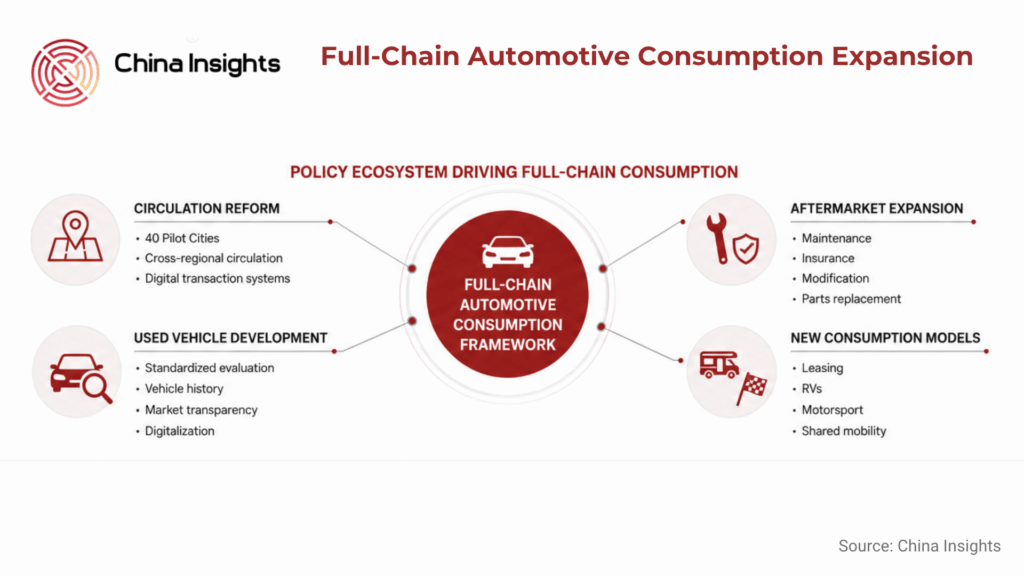
The policy introduces a “full-chain” automotive consumption framework covering the entire lifecycle of vehicles. This includes production, sales, usage, maintenance, recycling, and secondary market circulation. The objective is to reduce structural bottlenecks in vehicle circulation and increase total lifecycle consumption value. The framework aims to improve efficiency in asset utilization and expand service-based revenue streams within the automotive sector. The policy signals a transition from transaction-based consumption models toward service-oriented and lifecycle-driven consumption systems.
Automotive Circulation Reform and Pilot Cities
A key policy component is the reform of automotive circulation systems. The Ministry of Commerce and eight other departments have designated 40 pilot cities to test reforms in vehicle circulation and related market mechanisms. These pilots focus on improving transparency in used car transactions, reducing administrative barriers, and enhancing cross-regional vehicle circulation efficiency. The reform is intended to address inefficiencies in the secondary car market, which has historically been constrained by regional registration barriers and fragmented data systems. The policy also supports digitalization of vehicle transaction systems to improve market liquidity and pricing efficiency.
Expansion of Automotive Aftermarket Services
The policy places strong emphasis on the development of automotive aftermarket services. This includes vehicle maintenance, modification, insurance services, and parts replacement markets.
Authorities are promoting standardized development of vehicle modification services and encouraging regulated expansion of customization markets. This represents a structural shift toward value-added services beyond vehicle ownership. Insurance and maintenance integration is also expected to expand, improving lifecycle monetization of vehicles. The policy direction supports the development of a more mature automotive service economy aligned with consumption upgrading trends.
New Consumption Models: RVs, Motorsport, and Leasing
The policy explicitly supports new automotive consumption models, including recreational vehicles (RVs), motorsport activities, and vehicle leasing services. These segments are positioned as emerging consumption drivers with higher service intensity and longer lifecycle engagement. The inclusion of motorsport and RV markets reflects an effort to diversify automotive consumption beyond traditional passenger vehicle ownership. Leasing and shared mobility models are also encouraged as part of broader asset utilization optimization strategies.
Used Vehicle Market Development
The used vehicle market is identified as a key growth area under the full-chain consumption framework. Policy measures focus on improving circulation efficiency, standardizing evaluation systems, and reducing transaction frictions. Authorities aim to strengthen data infrastructure for vehicle history tracking and condition assessment. This is expected to improve trust in secondary market transactions. The development of a more transparent used vehicle market is intended to increase overall vehicle turnover and stimulate new vehicle demand indirectly.
Policy Coordination and Industrial Linkages
The automotive consumption expansion strategy is closely linked to industrial policy objectives. The framework supports automotive manufacturing upgrading, digital platform integration, and smart mobility ecosystem development. The coordination between consumption policy and industrial upgrading reflects China’s broader macroeconomic strategy of aligning demand-side and supply-side reforms. The policy also integrates automotive development with digital economy initiatives, particularly in data platforms and intelligent transportation systems.
Demand Stabilization and Economic Objectives
The policy package is designed to stabilize domestic demand in the automotive sector, which remains a key pillar of China’s consumption economy. By expanding the full lifecycle value of vehicles, authorities aim to increase total consumption volume without relying solely on new vehicle sales growth. This approach supports more sustainable demand patterns and reduces cyclical volatility in automotive sales. The strategy also contributes to broader macroeconomic stabilization objectives by strengthening durable goods consumption.
What this means for business
The full-chain automotive consumption policy signals a structural transformation of China’s automotive market from product-centric sales to service-centric lifecycle consumption.
- For automakers, the policy increases the importance of after-sales ecosystems, financing services, and used vehicle platforms. Revenue models will increasingly depend on lifecycle engagement rather than one-time sales.
- For mobility service providers and aftermarket companies, the policy expands addressable markets in maintenance, modification, leasing, and shared mobility services.
- For investors and insurers, the development of standardized used car markets and expanded service ecosystems creates new opportunities in asset valuation, risk pricing, and mobility-related financial services.
Overall, the policy reinforces a long-term shift toward integrated automotive consumption ecosystems supported by digital infrastructure and coordinated regulatory frameworks.
Source
https://www.gov.cn/zhengce/202606/content_7073838.htm
Author
Dr. Richard van Ostende

Related Articles