
China Signals Opening of NEV Repair Technical Access: After-Sales Market Restructuring and Competition Policy Shift
Executive Summary
- China is promoting greater openness in NEV repair technical authorization systems.
- Focus is on improving access to repair data, maintenance systems, and technical documentation.
- Objective is to enhance after-sales market competition and service accessibility.
- The policy addresses structural concerns over closed ecosystems in NEV servicing networks.
- Expected impact includes expanded independent repair markets and improved consumer rights protection.

Policy Context and Regulatory Orientation
The policy discussion on NEV repair technical authorization is presented in a China Government Network policy interpretation article titled “Guiding NEV companies to open repair technical authorization” (“引导新能源车企开放维修技术授权”). The article reflects a regulatory interpretation rather than a formal binding regulation. It highlights the policy direction of relevant Chinese authorities in improving the transparency and accessibility of NEV after-sales service systems. The underlying policy objective is to address structural limitations in the NEV after-sales ecosystem, particularly the high level of technical integration and proprietary control exercised by original equipment manufacturers (OEMs).
Structural Characteristics of NEV After-Sales Systems
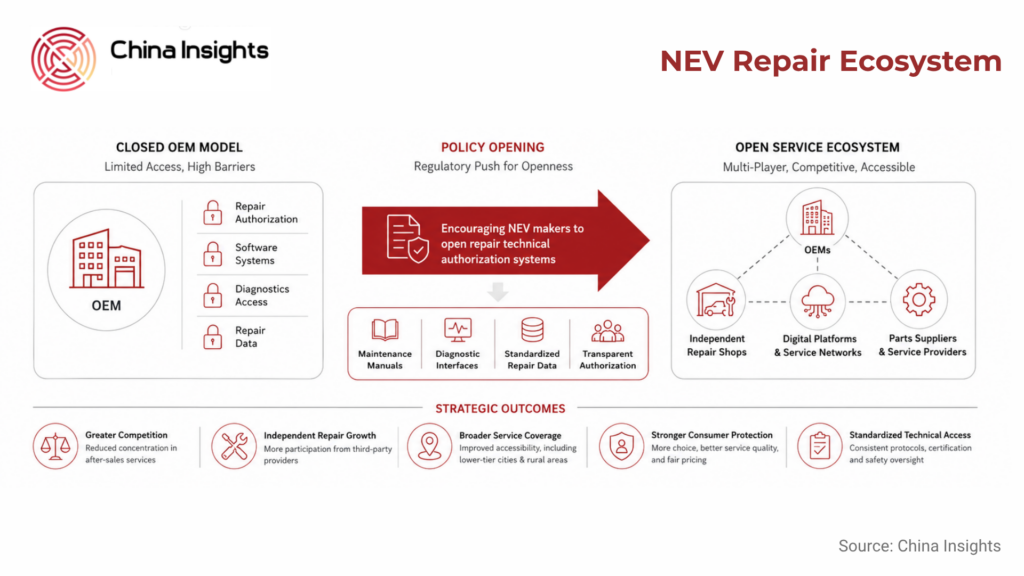
The NEV sector in China is characterized by highly integrated digital and mechanical systems. Vehicle control systems, battery management systems, and diagnostic tools are often tightly controlled by manufacturers. This creates a closed after-sales service environment where independent repair providers face technical access barriers. These barriers include limited diagnostic data access, restricted software systems, and proprietary maintenance protocols. The policy discussion identifies these characteristics as structural constraints on market competition and service diversification.
Opening of Repair Technical Authorization Systems
A central policy direction is encouraging NEV manufacturers to provide broader access to repair technical authorization systems. This includes maintenance manuals, diagnostic interfaces, and standardized repair data. The objective is to reduce information asymmetry between OEMs and independent repair providers. It also aims to improve interoperability in repair and maintenance ecosystems. The policy encourages manufacturers to establish more transparent authorization mechanisms for third-party service providers. This shift is intended to support the development of a more competitive and diversified after-sales service market.
Market Competition and After-Sales Service Structure
The policy direction focuses on improving competition in the NEV after-sales market. Currently, many NEV manufacturers operate vertically integrated service systems that limit the participation of independent repair operators. By promoting openness in technical authorization, regulators aim to reduce market concentration in after-sales services. This is expected to enable independent repair shops to expand service offerings for NEVs. Increased competition is expected to improve service quality, reduce maintenance costs, and enhance consumer choice. The policy also supports the development of standardized service pricing mechanisms across the sector.

Consumer Rights and Service Accessibility
A key regulatory motivation is strengthening consumer rights in the NEV maintenance market. Limited access to repair services can increase service costs and reduce convenience for vehicle owners. By improving technical access for independent repair providers, the policy aims to expand service coverage and reduce geographic disparities in maintenance availability. This is particularly relevant in lower-tier cities and rural regions, where OEM-authorized service networks may be limited. The policy direction aligns with broader consumer protection objectives in China’s automotive regulatory framework.
Data Access and Digital Repair Systems
NEVs rely heavily on digital systems for diagnostics and performance management. Access to vehicle data is therefore a critical component of repair capability. The policy discussion highlights the importance of standardized access to diagnostic interfaces and repair-related data systems. Regulators are expected to encourage the development of secure and standardized data-sharing mechanisms between manufacturers and authorized service providers. This includes balancing data security concerns with the need for market openness and service efficiency.
Impact on OEM Business Models
The opening of repair technical authorization systems may have significant implications for NEV manufacturers’ business models. Many OEMs currently derive substantial revenue from captive after-sales service networks. Increased openness could reduce exclusivity in maintenance services and increase competition from independent providers. However, OEMs may also benefit from broader ecosystem expansion, including authorized third-party partnerships and standardized service networks. The policy direction suggests a gradual transition toward more platform-based service ecosystems rather than fully closed service models.
Development of Independent After-Sales Markets
The policy supports the expansion of independent repair and maintenance markets for NEVs. This includes third-party repair shops, parts suppliers, and diagnostic service providers. A more open technical authorization system would allow independent operators to participate more effectively in NEV servicing. This is expected to increase market diversity and reduce dependence on OEM-controlled service channels. It may also stimulate innovation in specialized repair services and localized maintenance solutions.
Standardization and Regulatory Oversight
The policy direction also emphasizes the need for standardized technical frameworks. Opening repair systems requires consistent protocols for data access, certification, and service quality control. Regulators are expected to develop clearer standards for repair authorization processes and compliance requirements for service providers. This includes defining minimum technical requirements for independent repair operators and ensuring consistent safety standards across service networks. Standardization is intended to ensure that increased market openness does not compromise vehicle safety or service reliability.
Industry Transition and Competitive Dynamics
The NEV aftermarket is undergoing structural transformation driven by digitalization and electrification. The policy accelerates this transition by encouraging broader participation in repair ecosystems. Competitive dynamics are expected to shift from closed OEM service dominance toward multi-layered service ecosystems involving OEMs, independent providers, and digital platforms. This transition may lead to increased specialization in repair services and greater segmentation of the after-sales market. It also reflects a broader regulatory trend toward balancing innovation control with market openness.
What this means for business
The policy direction on NEV repair technical authorization signals a gradual restructuring of China’s automotive after-sales market.
- For NEV manufacturers, the key implication is the need to adapt business models to a more open service environment while maintaining control over core technologies and brand standards.
- For independent repair providers, the policy creates new market entry opportunities, particularly in diagnostics, maintenance, and localized service networks.
- For investors and service platform operators, the opening of technical authorization systems represents a structural growth opportunity in automotive after-sales services, supported by regulatory backing for increased market competition.
Overall, the policy reflects a shift toward more open, standardized, and competitive NEV service ecosystems in China.
Source
https://www.gov.cn/zhengce/202606/content_7073135.htm
Author
Dr. Richard van Ostende

Related Articles