
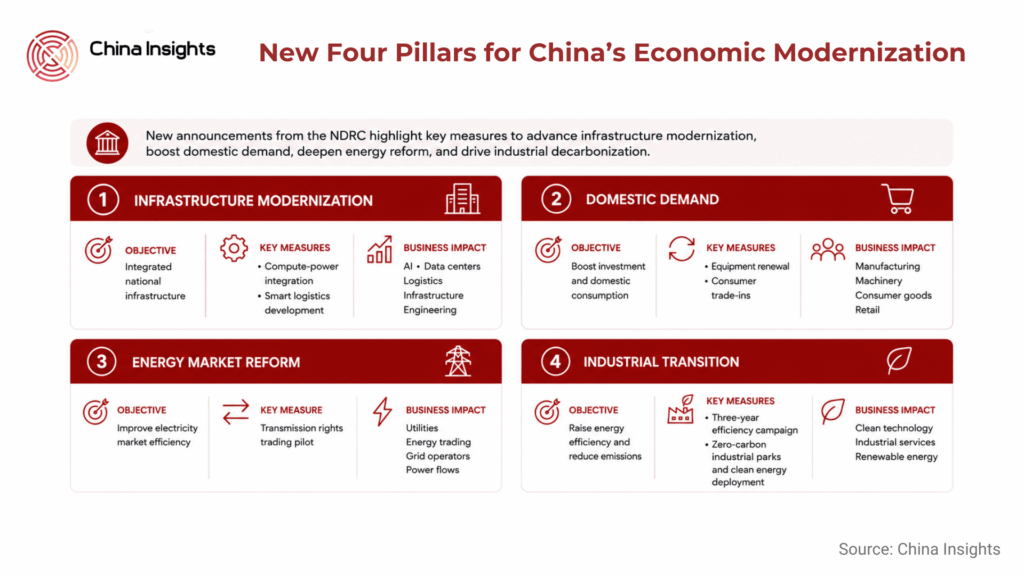
Strengthening National Infrastructure Networks
The NDRC identified major infrastructure networks as a key foundation for economic development and industrial modernization.
China has established an “8+10+3” computing infrastructure layout consisting of eight national computing hubs, ten computing clusters, and three integrated computing-power regions. By the end of March 2026, intelligent computing capacity had reached 2.5 times the level recorded one year earlier.
During the 15th Five-Year Plan period, authorities will focus on improving coordination between computing infrastructure, power grids, and communications networks. Planned measures include expanding direct connections between computing hubs, strengthening computing-power and electricity integration, and improving nationwide resource allocation.
Read more about their general Six Network Strategy.
Expanding Logistics Infrastructure
China continues to invest in logistics infrastructure to improve supply chain efficiency.
Current achievements include the construction of major logistics corridors, more than 2,700 large-scale logistics parks, and the release of over 210 national logistics standards during the 14th Five-Year Plan period.
The NDRC acknowledged remaining challenges, including insufficient rail connections to ports and industrial parks and limited efficiency in multimodal transport. To address these issues, authorities will introduce a dedicated logistics development plan under the 15th Five-Year Plan.
The strategy will focus on expanding urban and rural logistics networks, improving last-mile delivery systems, and accelerating deployment of digitalized and green logistics equipment. By 2030, China aims to establish a more integrated, intelligent, and sustainable logistics network.
Expanding the Impact of the “Two New” Policies
The government’s equipment renewal and consumer trade-in programs continue to support investment and domestic consumption.
According to the NDRC, RMB 185.1 billion has been allocated through two rounds of equipment renewal funding, supporting more than 11,000 projects with total investment exceeding RMB 840 billion.
Consumer trade-in programs have also expanded. During the first five months of 2026, authorities allocated RMB 125 billion, generating more than RMB 820 billion in related product sales and benefiting over 110 million consumers.
Read more about Consumer Trade-in Programs.
The support scope has been broadened to include residential elevator replacement and equipment upgrades in elderly care facilities. To date, approximately 194,000 aging residential elevators have been upgraded through the program.
Authorities plan to complete allocation of all 2026 funding before the end of June while strengthening supervision to prevent subsidy fraud and market manipulation.
Launch of Transmission Rights Trading
China has taken a further step toward electricity market liberalization through the introduction of transmission rights trading.
Transmission rights allow market participants to utilize electricity transmission channels during specified periods and within specified capacity limits. The mechanism aims to improve utilization of transmission infrastructure and facilitate cross-regional electricity flows.
The first pilot project was launched on the Yunxiao Direct Current transmission line on 1 June 2026. On 11–12 June, China’s first transaction was completed, involving the transfer of approximately 21.16 million kilowatt-hours of electricity from Anhui Province to Guangdong Province.
The NDRC stated that the reform aims to improve allocation of transmission resources, create market-based cost recovery mechanisms, and optimize electricity distribution across regions.
Additional transmission corridors may be included following evaluation of the pilot.
Accelerating Industrial Decarbonization
The NDRC also announced new measures to improve energy efficiency and reduce emissions in energy-intensive industries.
A three-year campaign will target nine sectors: steel, electrolytic aluminum, cement, flat glass, oil refining, ethylene, synthetic ammonia, methanol, and coal-fired power generation. By the end of 2028, authorities aim to increase the share of production capacity meeting energy-efficiency benchmark standards by an average of 20 percentage points across these industries. For coal-fired power generation, the target increase is 15 percentage points.
The campaign also aims to eliminate production capacity operating below mandatory energy-efficiency standards.
Read more on the three-year campaign.
For new projects, authorities will promote cleaner energy structures, green direct power supply models, and greater use of renewable energy. Local governments are encouraged to increase investment in zero-carbon industrial parks and zero-carbon transport corridors.
What This Means for Business
The latest NDRC announcements highlight four areas likely to generate business opportunities: digital infrastructure, logistics modernization, equipment renewal, and clean energy development.
Technology companies, data center operators, power infrastructure providers, and logistics firms may benefit from continued infrastructure investment. Manufacturers could see additional demand through equipment renewal programs, while consumer goods companies may continue to benefit from trade-in subsidies.
The launch of transmission rights trading signals further electricity market reform and could create new opportunities for energy market participants. At the same time, companies operating in energy-intensive industries should prepare for stricter energy efficiency requirements and accelerated decarbonization targets.
Businesses involved in industrial energy management, renewable energy, emissions reduction technologies, and green infrastructure are likely to benefit from policy support during the 15th Five-Year Plan period.