
Analyzing Guangzhou's New Airport Project
China’s aviation infrastructure pipeline continues to expand, and Guangzhou’s new airport represents one of the most significant greenfield airport projects currently underway in the country. With a ceremony held on March 25, 2026, the project has moved from planning into active construction, signaling a multi-year procurement and development cycle that will engage a broad range of industry players.
Executive Summary
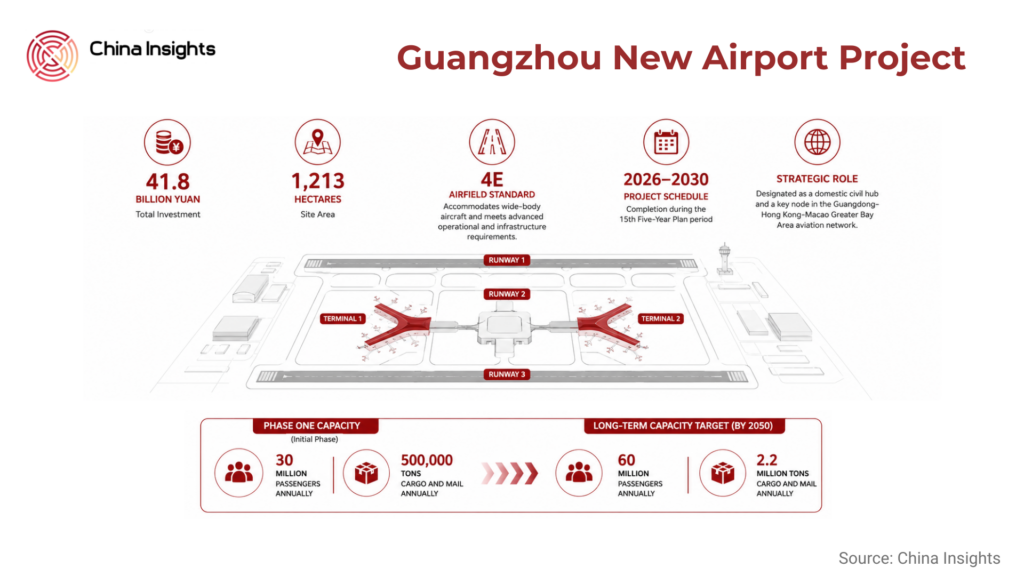
Total project investment stands at 41.8 billion yuan, covering approximately 1,213 hectares
The airport is planned for three runways and two terminals, rated at 4E airfield standard
Phase one targets 30 million passengers and 500,000 tons of cargo annually
Long-term capacity is designed for 60 million passengers and 2.2 million tons of cargo by 2050
The project is scheduled for completion during the 15th Five-Year Plan period (2026–2030)
The airport is designated as a domestic civil hub and a key node in the Guangdong-Hong Kong-Macao Greater Bay Area aviation network
Project Scale and Location
Guangzhou New Airport is situated in Genghe Town, Gaoming District, Foshan City, positioning it at the geographic center of four Pearl River Delta cities: Foshan, Zhaoqing, Jiangmen, and Yunfu. The catchment area directly serves a population exceeding 20 million people. The site covers approximately 1,213 hectares, a substantial land footprint that reflects the scale of civil engineering, drainage, utilities, and ground infrastructure work required before any above-ground construction commences.
The 4E airfield rating is a technical benchmark that defines the physical and operational standards for runway length, taxiway width, and aircraft classification. This rating accommodates wide-body aircraft and establishes clear specifications for pavement engineering, lighting systems, navigation aids, and air side infrastructure, all of which translate directly into procurement requirements for suppliers operating in those categories.
Infrastructure Scope and Construction Phases
The plan includes three runways and two terminals. Phase one is engineered to handle 30 million passengers annually and 500,000 tons of cargo and mail.
For construction firms, the scope encompasses earthworks at scale, runway and taxiway pavement, terminal superstructure, baggage handling infrastructure, fuel farm construction, air traffic control facilities, and the full range of utilities and ground transportation connections required to make a hub airport functional. The project is expected to run through to the end of the 15th Five-Year Plan period, meaning contractors and suppliers should anticipate a sustained engagement window running through 2030.
Strategic Role in the Greater Bay Area
The airport’s designation as a domestic civil hub and a key component of the Guangdong-Hong Kong-Macao Greater Bay Area aviation network carries direct implications for its operational specifications. The stated goal is to address the current shortage of civil aviation capacity on the west bank of the Pearl River Estuary, creating an east-west balance alongside Guangzhou Baiyun, Shenzhen Bao’an, Hong Kong, and Macau airports.
The positioning as a complementary hub suggests the airport will be designed and equipped to handle specific traffic profiles, likely with an emphasis on domestic connectivity and cargo given the industrial and manufacturing character of its catchment region. For terminal designers, system integrators, and ground handling equipment suppliers, understanding this traffic profile is essential to aligning product and service offerings with the airport’s actual operational mandate.
Long-Term Capacity Targets
The 2050 design targets, 60 million passengers and 2.2 million tons of cargo, provide a strategic planning horizon that extends well beyond the initial construction phase. These figures indicate that the infrastructure being built now must be designed with expansion in mind. For suppliers of airport technology systems, this means scalability and interoperability will be evaluation criteria from the outset.
Cargo capacity of 2.2 million tons by 2050 is a particularly relevant data point for logistics infrastructure specialists, cargo terminal designers, and cold chain facility providers. The Pearl River Delta remains one of the world’s most concentrated manufacturing and export zones, and a well-positioned cargo hub on the west bank of the estuary will attract freight volumes that require purpose-built handling infrastructure.
What This Means for Business
For the full spectrum of companies involved in airport development, civil contractors, terminal architects, systems integrators, equipment suppliers, and specialist service providers, Guangzhou New Airport represents a defined, long-duration opportunity with clear technical parameters.
The 41.8 billion yuan investment figure establishes the overall financial scale, though the allocation across civil works, terminal construction, systems, and equipment will be distributed across multiple procurement packages and contract cycles over the coming years. Companies that position themselves early in the project pipeline, through partnerships with Chinese state-owned enterprises, engagement with local government procurement processes, or alignment with the relevant design institutes.
The 4E rating, three-runway layout, and dual-terminal configuration provide sufficient technical detail for suppliers to begin assessing fit against their product and service portfolios now. The long-term cargo targets suggest that airside logistics infrastructure will be a material component of the overall build, making this relevant not only to passenger terminal specialists but to the full range of cargo and ground handling equipment providers.
Source
https://www.ndrc.gov.cn/xwdt/ztzl/ygadwqjs1/202604/t20260408_1404557.html
Author
Dr. Richard van Ostende

Related Articles