
China Moves to Build an Integrated National Logistics Network
China is moving to a more integrated approach to logistics infrastructure. On 18 August 2026, the National Development and Reform Commission (NDRC) and the Ministry of Transport (MOT) jointly issued the Implementation Plan for Logistics Network Development (《物流网建设实施方案》), with State Council approval.
The plan marks a shift from expanding individual logistics facilities and transport links toward building a connected national logistics network. It covers infrastructure, multimodal transport, international logistics, digitalization, green equipment, information sharing and supporting rules. The objective is to improve the efficiency and resilience of the movement of goods and resources across China.
Executive summary
- China is moving logistics infrastructure from individual points and corridors toward integrated networks.
- The policy links logistics hubs more closely with industrial clusters, transport corridors and regional economic development.
- Multimodal transport and cross-regional connectivity are receiving greater attention.
- Digitalization, green equipment and logistics data sharing are becoming core elements of infrastructure development.
- International logistics infrastructure is being integrated more closely with domestic logistics networks.
- New standards, financing mechanisms and land-use coordination are intended to support private-sector participation.
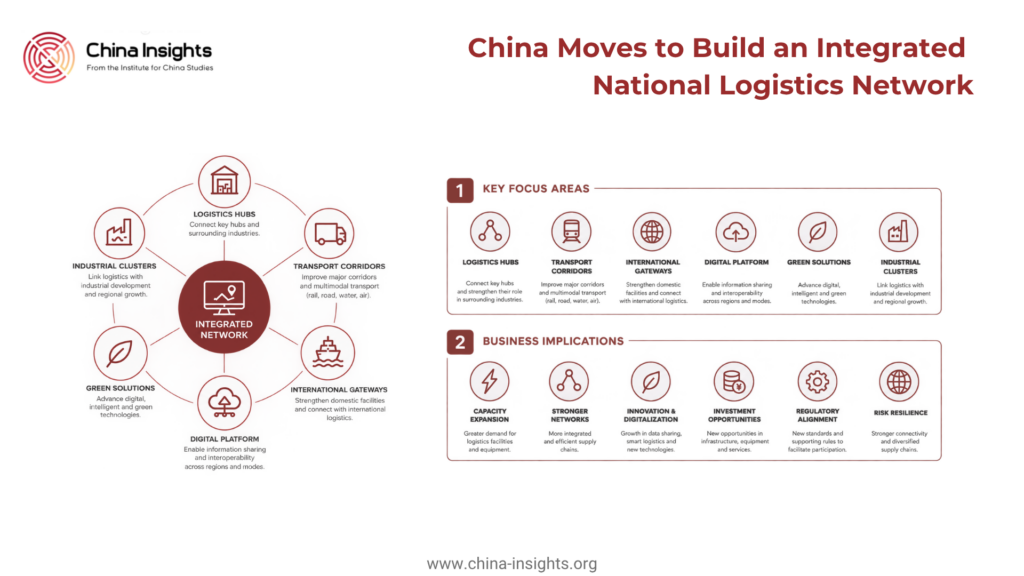
From logistics projects to an integrated network
The most important change is the move from what Chinese authorities describe as “point-and-line” development toward a networked logistics system. The NDRC and MOT identify weaknesses in hub connectivity, transport-mode integration, urban and rural facilities, international logistics support, digitalization and information sharing.
The new approach therefore treats logistics as a system rather than a collection of separate assets. Hubs, corridors, vehicles, standards and information systems are expected to operate as an integrated network. This is intended to improve asset utilization and reduce bottlenecks between different stages of the supply chain.
Logistics hubs become network infrastructure
The plan places greater emphasis on the role of major logistics hubs. Rather than developing hubs as individual distribution centers, China intends to strengthen their network functions and their links with surrounding industrial activity.
This creates closer alignment between logistics planning and regional economic development. Local authorities are expected to coordinate logistics networks with industrial layouts, comprehensive transport systems and urban-rural development. For logistics operators, this should increase the importance of location within wider networks rather than proximity to a single market.
Multimodal transport becomes a core priority
The plan also raises the importance of connecting different transport modes. Domestic trunk logistics corridors will be strengthened, while rail, road, waterway and aviation services are expected to connect more effectively through multimodal transport and collection-and-distribution systems.
This is relevant to companies with complex supply chains. Better connections between transport modes can reduce transfer costs and improve reliability. It also creates demand for intermodal terminals, logistics equipment, digital coordination systems and integrated logistics services.
International logistics is integrated with domestic networks
International logistics receives a dedicated component of the plan. The policy calls for stronger domestic support for international logistics and improved connections between domestic and international logistics systems.
This reflects the growing importance of logistics infrastructure to China’s foreign trade and supply-chain resilience. For companies engaged in international manufacturing and distribution, the relevant logistics proposition will increasingly include the complete connection between domestic production locations, national logistics corridors and international gateways.
Digital and green infrastructure moves into the mainstream
Digitalization and decarbonization are no longer treated as separate logistics-sector initiatives. The plan calls for the digital and green transformation of logistics facilities and equipment, including the development and application of new logistics equipment.
Information connectivity is equally important. China plans to improve logistics information standards and expand interoperability and data sharing. The policy aims to improve the matching of supply and demand and the allocation of logistics resources across the wider market.
This creates a broader market for warehouse automation, intelligent logistics equipment, digital platforms, data services and energy-efficient infrastructure. It also increases the importance of interoperability between systems and compliance with emerging technical standards.
Standards and financing support implementation
The plan places more emphasis on the “soft infrastructure” required for the logistics network to function. The NDRC and MOT intend to strengthen standards for multimodal transport, logistics hubs, digital and green logistics, while improving coordination of rules across transport modes and regions.
The authorities also intend to use government funding to leverage market-based financing. Financial institutions are encouraged to provide appropriately structured credit for logistics-network projects. Land, water and other factor requirements are also to be coordinated with spatial planning.
A new market for integrated logistics capabilities
The implementation approach favors companies able to connect different parts of the logistics system. The policy specifically supports the development of internationally competitive logistics enterprises and integrated logistics service providers. It also encourages mergers, strategic cooperation and closer integration between logistics companies, manufacturing and commercial distribution.
This could accelerate consolidation in parts of the logistics sector. Scale, network coverage and the ability to integrate assets and data are likely to become increasingly important competitive advantages.
What this means for business
- Infrastructure investment: Demand should increase for logistics hubs, multimodal facilities, intelligent warehouses and supporting equipment.
- Integrated logistics services: Companies able to combine transport, warehousing, distribution and digital services should benefit from the network approach.
- Technology suppliers: Automation, logistics software, data platforms and green equipment are becoming strategic parts of logistics infrastructure.
- Supply-chain planning: Manufacturing and trading companies should assess logistics locations based on network connectivity rather than individual transport links.
- International trade: Stronger integration between domestic and international logistics could improve supply-chain connectivity and resilience.
- Standards and compliance: Companies should monitor emerging standards for multimodal transport, digital logistics, green equipment and cross-regional information exchange.
Source
https://www.gov.cn/zhengce/202609/content_7080083.htm
Author
Dr. Richard van Ostende

Related Articles