
China Launches Joint Enforcement Campaign to Tighten Oversight of Used EV Battery Recycling
China is intensifying regulatory oversight of the new energy vehicle (NEV) battery recycling industry as retired power batteries become an increasingly important source of strategic raw materials. On 27 April 2026, five ministries jointly issued the Notice on Launching a Joint Law Enforcement Special Action to Regulate the Recycling and Utilization of Used Power Batteries.
The initiative introduces a coordinated national enforcement campaign targeting illegal practices across the entire battery recycling value chain. Rather than creating new regulatory obligations, the campaign focuses on strengthening enforcement of existing regulations through cross-ministerial cooperation, information sharing and coordinated inspections.
Executive Summary
Authorities will target illegal dismantling, unauthorized sales, environmental violations, false traceability reporting, and unlicensed operations.
The enforcement campaign runs from April to June 2026 in three implementation phases.
The initiative strengthens supervision across the entire battery lifecycle, from collection and transportation to recycling and product manufacturing.
Businesses involved in battery recycling, logistics, vehicle dismantling, and battery manufacturing should expect increased inspections and stricter enforcement.
Why China is Strengthening Battery Recycling Enforcement
China’s electric vehicle market has entered a new phase in which large numbers of first-generation power batteries are reaching the end of their service life. As a result, the volume of retired batteries requiring proper collection and recycling continues to increase rapidly.
According to the policy interpretation released by MIIT, China recycled more than 400,000 tons of used NEV power batteries in 2025, representing a 32.9% year-on-year increase. Recovery rates for strategic metals including lithium, cobalt, and nickel have reached internationally advanced levels among leading recycling enterprises.
Despite these achievements, authorities identified persistent challenges, including illegal battery trading, environmentally harmful dismantling practices, weak compliance with traceability requirements, and unlicensed recycling activities. The latest campaign is intended to address these issues through coordinated enforcement.
A Full-Chain Regulatory Approach
A key feature of the campaign is its emphasis on supervising every stage of the battery recycling ecosystem instead of focusing on individual market participants.
Authorities aim to establish a collaborative enforcement mechanism that combines the responsibilities of multiple government agencies. Information sharing and joint inspections are intended to improve oversight while reducing regulatory gaps between different parts of the supply chain.
The campaign also seeks to strengthen deterrence by increasing investigations, imposing administrative penalties where appropriate, and publicly disclosing representative enforcement cases.
Responsibilities Assigned to Individual Authorities
The Notice clearly divides enforcement responsibilities among the participating ministries.
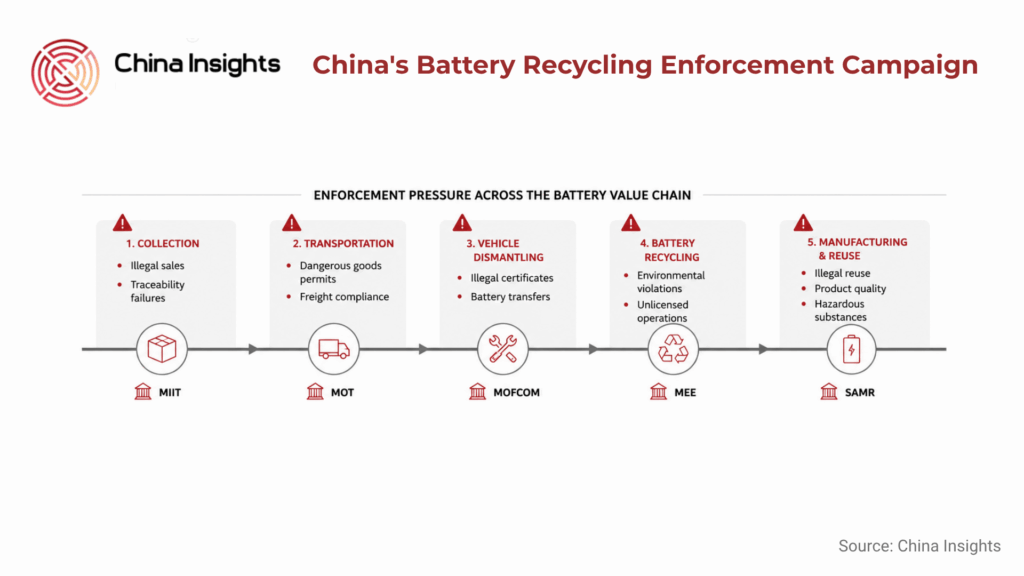
The Ministry of Industry and Information Technology will focus on supervising battery traceability systems and monitoring the transfer of retired power batteries. It will investigate failures to upload required traceability information, submission of false information, and illegal battery sales.
The Ministry of Ecology and Environment will concentrate on environmental compliance. Enforcement will target unauthorized construction projects, illegal pollutant discharges, and violations relating to industrial solid waste management during battery recycling and disposal.
The Ministry of Transport will strengthen supervision of battery transportation. Authorities will investigate the unauthorized transport of used power batteries without the required dangerous goods transport permits and monitor compliance among freight operators and vehicle repair companies.
The Ministry of Commerce will oversee vehicle dismantling enterprises and the recycling of scrapped vehicles. Enforcement will focus on illegal issuance of dismantling certificates, improper battery sales, and failures to comply with battery traceability requirements.
The State Administration for Market Regulation will strengthen product quality supervision, particularly for lithium batteries used in electric bicycles and similar products. Authorities will crack down on the illegal reuse of retired EV power batteries in consumer mobility products and investigate unlicensed production and the use of prohibited hazardous substances.
Three-Phase Enforcement Timeline
The special enforcement campaign is structured around three implementation stages between April and June 2026.
The first stage, completed by the end of April, focuses on collecting evidence and identifying illegal activities, including unauthorized dismantling and illegal battery sales. Authorities use this period to prepare for targeted enforcement actions.
During the second stage, which runs through May, regulators conduct coordinated inspections and joint law enforcement operations. Enforcement efforts focus on identifying non-compliant enterprises while encouraging businesses to fulfill their legal responsibilities.
The final stage concludes by the end of June. Authorities will publish representative enforcement cases, strengthen the deterrent effect through public disclosure, and evaluate the overall effectiveness of the campaign.
Greater Focus on Battery Traceability
China has invested significantly in establishing digital systems that record the movement of power batteries throughout their lifecycle. Accurate reporting is intended to ensure batteries are transferred only to qualified recycling enterprises while enabling regulators to monitor compliance.
The campaign specifically targets businesses that refuse to submit traceability information or provide false reporting. This indicates that digital compliance will become an increasingly important element of regulatory supervision across the recycling industry.
Read more about battery traceability.
What this means for business
China’s latest enforcement campaign demonstrates that battery recycling has become a strategic policy priority linked to resource security, environmental protection, and the sustainable development of the country’s electric vehicle industry.
The Notice does not introduce a new regulatory framework. Instead, it significantly increases the intensity of enforcement through coordinated action by five central government authorities. Businesses should therefore focus not only on understanding regulatory requirements but also on ensuring that compliance systems can withstand increased inspections.
Companies involved in the collection, transportation, dismantling, recycling, or reuse of power batteries should pay particular attention to traceability reporting, environmental compliance and licensing requirements. Organizations with strong compliance systems are likely to be better positioned as regulatory enforcement continues to intensify.
Source
https://wap.miit.gov.cn/zwgk/zcjd/art/2026/art_88d410f4b8ff42be9b49c7bd3d1f7454.html
Author
Dr. Richard van Ostende

Related Articles