
China's Small and Micro Passenger Vehicle Rental Sector Gets a Three-Year Policy Boost
China’s central government has issued a three-year action plan to accelerate the development of its small and micro passenger vehicle rental sector. Released in June, 2026, the Three-Year Action Plan for Promoting High-Quality Development of Small and Micro Passenger Vehicle Rental (2026–2028) was jointly published by ten ministries and agencies led by the Ministry of Transport. The plan sets binding targets for network expansion, service digitalization, and market regulation through 2028.
For international businesses, particularly those active in tourism, automotive supply chains, and mobility services, the plan opens concrete entry points into a policy-backed growth corridor that is now moving on a defined timeline.
Executive Summary
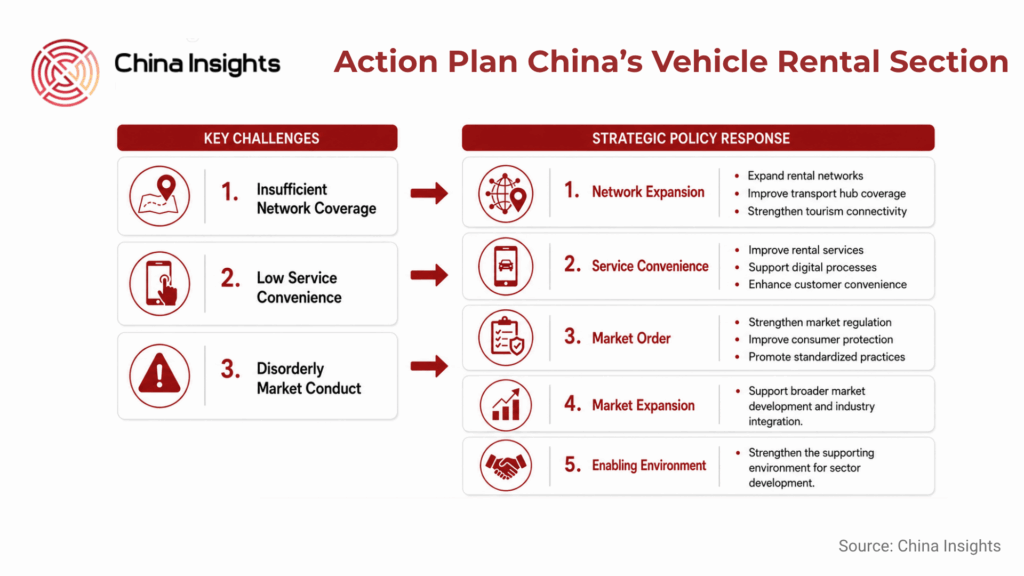
The plan identifies three core problems: insufficient network coverage, low service convenience, and disorderly market conduct.
Thirteen specific tasks are organized under five strategic pillars: network expansion, service convenience, market order, market space, and enabling environment.
Key targets include full rental coverage at qualifying airports and high-speed rail stations, free cross-city vehicle returns in major city clusters by 2028, and 30,000 new EV charging guns at highway service areas by end-2028.
The plan integrates rental services with tourism, the automotive industry, and digital infrastructure.
Background and Policy Context
China’s car rental market has expanded rapidly in recent years, driven by rising incomes, domestic tourism growth, and increasing consumer preference for self-drive travel. However, growth has been uneven. Rental networks remain thin outside major urban centers, cross-city vehicle returns are often costly or unavailable, and market conduct, particularly pricing transparency and consumer dispute resolution, has lagged behind consumer expectations.
The action plan aligns with China’s broader strategy to boost consumption and expand service-sector growth. It also supports the 15th Five-Year Plan’s emphasis on automotive aftermarket services, including vehicle rentals.
Read more about the Boost for Domestic Consumption.
Network Expansion: Airports, Rail Stations, and Tourism Corridors
The plan sets a concrete infrastructure target: rental service points must be established at civil aviation airports handling over one million passengers annually and at second-tier and above high-speed rail stations, positioning rental services as a direct extension of intercity travel.
Beyond transport hubs, the plan targets four major city clusters, Beijing-Tianjin-Hebei, the Yangtze River Delta, the Guangdong-Hong Kong-Macao Greater Bay Area, and the Chengdu-Chongqing Economic Circle, along with locations near 5A-rated tourist destinations. Operators in these areas are expected to provide one-stop services covering vehicle pick-up, drop-off, and cross-city return.
On infrastructure, the plan calls for 30,000 new EV charging guns (60kW and above) at highway service areas by end-2028, with additional charging and battery-swap facilities planned along tourist roads and national and provincial trunk roads.
Read more on EV Charging Infrastructure Plans.
Service Convenience: Cross-City Returns and Digital Processes
One of the measures is the push toward free cross-city vehicle returns. The plan requires rental operators to offer free returns within the four major city clusters and key tourist regions by end-2028. To facilitate this, vehicle registration data is to be mutually recognized across regions: intra-provincial recognition by end-2027, and inter-city recognition within the four city clusters by end-2028.
On the digital side, Driver’s license verification will be streamlined through unified identity checks.Operators are directed to expand “credit-based deposit-free rental,” doorstep vehicle delivery and collection, and fully contactless self-service pick-up and drop-off. By end-2027, major rental platforms must integrate a one-tap roadside assistance feature. The plan also includes measures to improve payment convenience for foreign visitors, addressing a known friction point for inbound tourism.
Market Order: Contracts, Credit, and Consumer Protection
The plan directs authorities to develop a standardized rental contract template clarifying both parties’ obligations on deposits, accident handling, traffic violations, and liability. Regulators are instructed to crack down on practices such as inflated vehicle damage assessments, a recurring consumer complaint in the sector.
A new credit evaluation framework for rental operators will be developed, with regular public disclosure of complaint rates and satisfaction scores. Furthermore, the data on renters who fail to process traffic violations or who unlawfully dismantle or resell rental vehicles will be shared across agencies and used to restrict repeat offenders.
Market Expansion: Insurance, Tourism Integration, and Auto Industry Linkages
Another bottleneck for new energy vehicles is the difficulty obtaining insurance, which is tackled through scientific recalibration of base insurance rates for rental vehicles and expansion of the “Easy Auto Insurance” platform. It also encourages financing leasing companies to partner with rental operators to strengthen the capital base of market participants.
Read more about new insurance models for EV’s.
On tourism integration, the plan supports bundled product development combining rental with hotel, ticketing, and itinerary planning services. Rental operators are encouraged to build out emergency vehicle replacement mechanisms for breakdowns on tourist routes. On the automotive supply chain side, the plan encourages group purchasing arrangements among smaller rental firms, deeper collaboration with manufacturers on bulk purchase and buyback schemes, and expansion into second-hand vehicle exports, an innovative mechanism to accelerate fleet renewal.
What This Means for Business
The plan raises the competitive bar while creating new growth opportunities across China’s mobility ecosystem. Operators with strong regional networks and fleet management capabilities will be best positioned to meet hub expansion and free cross-city return requirements, while smaller providers may face higher operating costs.
For automakers, particularly EV manufacturers facing oversupply, rental fleets represent a policy-backed sales channel supported by fleet electrification and bulk procurement. Tourism, hospitality, and mobility platforms also stand to benefit as the government promotes integrated travel products combining rental, accommodation, and ticketing.
Measures to simplify payments and identity verification for foreign visitors signal stronger policy support for inbound tourism. With implementation tied to clear 2027 and 2028 milestones, businesses have an unusually predictable investment window, although execution will depend on coordination across central and local governments.
Sources
https://www.mot.gov.cn/gongkai/zcjd/202606/t20260608_4207125.html
https://xxgk.mot.gov.cn/jigou/ysfws/202606/t20260605_4206926.html
Author
Dr. Richard van Ostende

Related Articles