
China Accelerates AI Industrialization and Governance
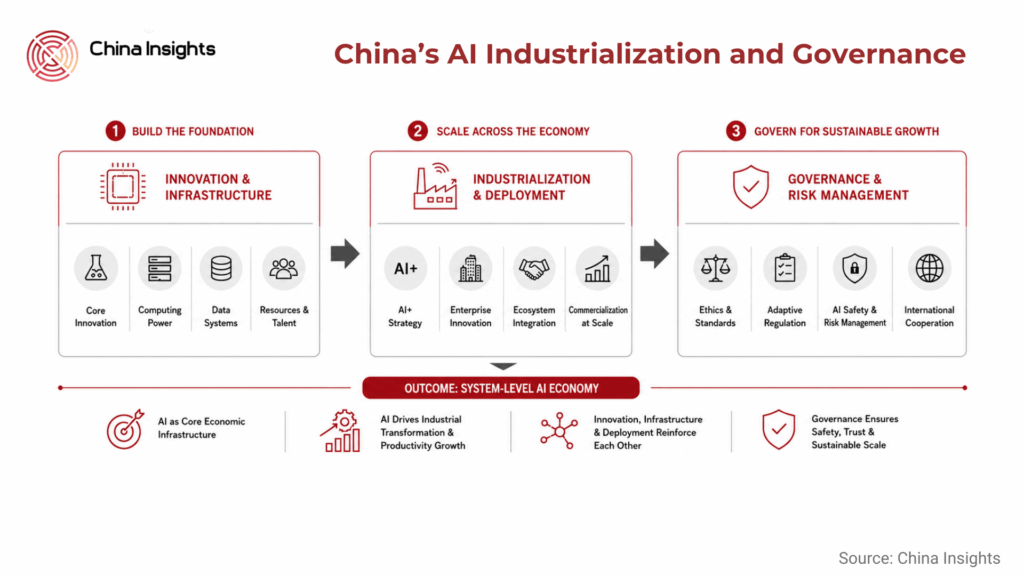
On 29 June 2026, China’s State Council set out a coordinated policy direction for artificial intelligence development, industrial application, and governance reform. The decisions signal a clear shift from AI capability building toward large-scale industrial deployment, supported by stronger infrastructure investment and more structured regulatory oversight. The policy direction positions artificial intelligence as a foundational driver of productivity growth and industrial transformation. At the same time, it reinforces the need for tighter governance systems, particularly around data, ethics, and system safety.
Executive Summary
- China is accelerating AI development with emphasis on core technology breakthroughs and system-level capability building.
- Computing power expansion and data infrastructure are treated as strategic bottlenecks to be resolved.
- The “AI+” strategy is the main vehicle for scaling AI across industries and real economy sectors.
- Enterprises are expected to take a stronger role in both innovation and application development.
- Governance frameworks will be strengthened through ethics rules, certification systems, and safety testing.
- A risk-tiered, adaptive regulatory model is being developed to manage fast-moving AI applications.
- International cooperation on AI governance is encouraged alongside domestic regulatory control.
AI as Strategic Infrastructure for Economic Transformation
Artificial intelligence is increasingly being treated as a core economic infrastructure rather than a standalone technology sector. The State Council emphasizes the need to align AI development with long-term industrial upgrading and productivity enhancement. This framing places AI alongside other foundational systems such as energy, transport, and digital networks. The underlying policy logic is that AI capability will determine competitiveness across nearly all sectors of the economy. At the same time, the government highlights the importance of maintaining strategic control over AI development pathways, ensuring that technological progress remains aligned with national development priorities.
Accelerating Core Innovation and Technology Breakthroughs
A central focus of the policy direction is accelerating breakthroughs in core AI technologies. The emphasis is not limited to applications but extends to foundational layers such as algorithms, model architecture, and system design. Enterprises are increasingly expected to participate in this innovation process. The policy signals a shift toward closer integration between research institutions and industrial actors, where companies contribute not only to commercialization but also to upstream innovation. To support this, resource allocation is being strengthened across funding channels, talent development systems, and research infrastructure. The objective is to reduce reliance on external technological ecosystems and build stronger domestic capability across the AI stack.
Computing Power and Data Systems as Core Constraints
The expansion of computing infrastructure is identified as a decisive factor for AI development. Large-scale intelligent computing clusters are being prioritized to support training and deployment of advanced models. Alongside computing capacity, data systems are receiving equal attention. Policy direction highlights the need to improve both the quality and usability of data, including better structuring, integration, and accessibility. This reflects a broader recognition that AI development is constrained not only by algorithms but also by underlying production factors. Computing power and data are now positioned as strategic inputs comparable to capital and labor in traditional economic models.
“AI+” Strategy: Scaling AI Across the Real Economy
The “AI+” initiative is emerging as the central mechanism for industrial integration of artificial intelligence. Rather than focusing on isolated pilots, the policy prioritizes large-scale deployment across manufacturing, services, logistics, and digital platforms. The underlying objective is to accelerate commercialization and embed AI into existing industrial systems. China’s broad manufacturing base and diverse service economy are seen as key advantages in enabling rapid diffusion. This approach reflects a demand-driven model of innovation, where the value of AI is measured not only by technological advancement but by its penetration into real economic activity.
Enterprise-Led Innovation and Ecosystem Expansion
Enterprises are positioned at the center of the AI development ecosystem. Their role extends beyond application deployment into research participation and system-level innovation. This marks a gradual shift toward an enterprise-led innovation structure, where firms act as intermediaries between scientific research and industrial scaling. The expectation is that companies will help translate technological advances into commercially viable products and services. The policy framework suggests a tighter integration between public innovation systems and private sector capabilities, particularly in scaling AI applications across industries.
Governance Evolution: From Static Regulation to Adaptive Oversight
As AI applications expand rapidly, governance systems are being restructured to become more adaptive. The State Council emphasizes strengthening ethics frameworks, testing standards, and certification mechanisms to ensure safe deployment. A tiered regulatory approach is being developed, where oversight intensity varies depending on risk level and application context. This allows for differentiated governance, balancing innovation with control. Rather than static rule-setting, the direction is toward continuous regulatory adaptation, enabling governance systems to evolve alongside technological change.
Strengthening AI Safety and Risk Management
Risk management is embedded throughout the policy framework. The focus is shifting toward early identification of risks and continuous monitoring of AI systems during deployment. Safety governance includes ethical compliance, technical testing, and certification procedures, particularly for high-risk use cases. The intent is to move from reactive intervention to preventive governance, reducing systemic risks before they materialize at scale.
International Cooperation with Strategic Boundaries
The policy direction also highlights the importance of participating in international AI governance discussions. This includes engagement in global standards development and regulatory coordination. At the same time, domestic governance autonomy remains central. The approach reflects a dual strategy: active participation in global rule-setting while maintaining independent regulatory control. This balance is likely to shape China’s positioning in future international AI governance negotiations.
Structural Implications: A System-Level AI Economy
Taken together, the policy direction signals a shift toward a system-level integration of artificial intelligence into the economy. Innovation is being scaled through coordinated enterprise participation and infrastructure expansion. Industrial transformation is being driven by mass deployment under the “AI+” framework. Governance is evolving toward adaptive, risk-tiered systems capable of managing rapid technological change. The result is a policy model in which AI is not treated as an industry, but as a cross-cutting capability embedded across economic systems.
What this means for business
For companies operating in China, the direction of policy creates both expansion pathways and structural adjustments.
AI adoption will increasingly become an operational requirement across industries rather than a discretionary investment. Firms will face stronger expectations to integrate AI into products, services, and internal processes. At the same time, access to computing infrastructure, data resources, and policy-supported innovation systems will become more important competitive factors.
Regulatory requirements around ethics, testing, and certification will become more formalized, particularly in high-impact applications. Finally, companies will need to navigate a more complex environment where innovation policy and governance systems evolve in parallel, requiring closer alignment between technology strategy and regulatory compliance.
Source
https://www.gov.cn/zhengce/202606/content_7073704.htm
Author
Dr. Richard van Ostende

Related Articles