
China’s Employment-First Strategy under the 15th Five-Year Plan
On 17 June 2026, the State Council of the People’s Republic of China issued the “Plan on Implementing the Employment-First Strategy during the 15th Five-Year Plan Period (2026–2030)”. The document defines the direction for employment policy coordination, labor market reform, and workforce development in the next planning cycle. Employment is elevated as a core policy objective linked to macroeconomic stability, industrial upgrading, and social cohesion.
The plan signals a structural adjustment in China’s labor market framework. It prioritizes demand-supply alignment, skills upgrading, and targeted support for vulnerable groups. It also further integrates employment policy with industrial policy, education reform, and technological development.
Executive Summary
- The State Council issued a national employment strategy for 2026–2030 under the 15th Five-Year Plan framework.
- Employment is positioned as a core macroeconomic and social stability objective.
- Key priorities include stabilizing labor-intensive sectors, expanding services employment, and developing jobs in emerging industries.
- Structural skills mismatches between labor supply and industrial demand are a central policy concern.
- Vocational training and education reform are key implementation tools.
- Targeted support is strengthened for graduates, migrant workers, veterans, and unemployed groups.
- Flexible and platform-based employment is formally recognized and regulated.
- Employment risk monitoring and early-warning systems are expanded to support macro stability.
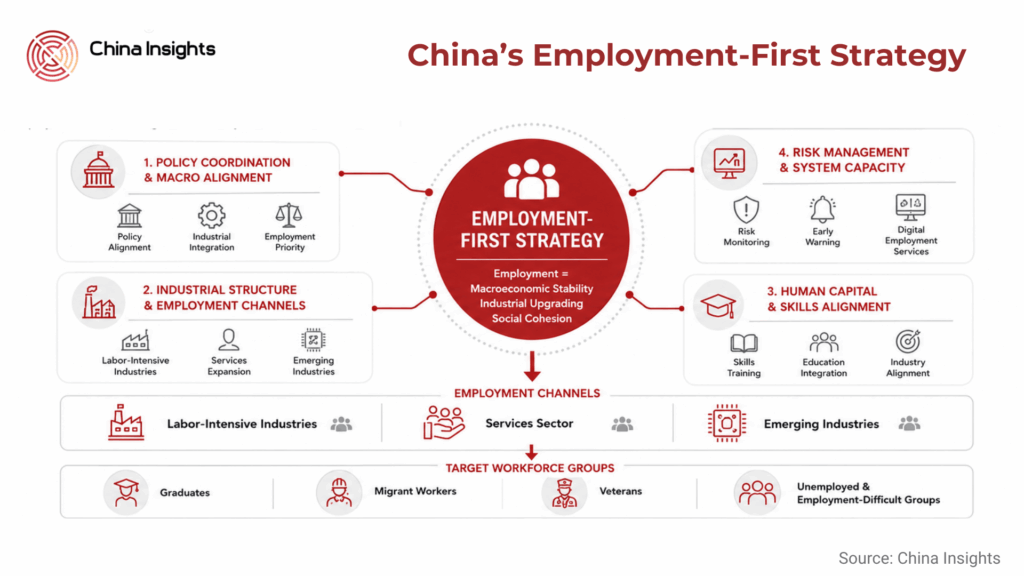
Policy Context: Employment as a Stability Instrument
The employment-first strategy continues China’s approach of linking labor market stability with macroeconomic governance. Employment is framed not only as a social issue but as a structural pillar of economic performance and risk control. The policy directly connects employment outcomes with growth quality, industrial transformation, and national stability. Preventing large-scale unemployment is defined as a baseline policy objective. This aligns with broader 15th Five-Year Plan priorities, including high-quality development, industrial upgrading, and innovation-driven growth.
Macroeconomic Coordination and Policy Synergy
A central pillar of the strategy is stronger coordination between employment policy and macroeconomic tools. The plan calls for closer alignment between fiscal policy, industrial policy, and labor market outcomes. Employment considerations are embedded into industrial policy design. Sectoral development strategies are expected to explicitly assess job creation capacity and labor absorption effects. Policy focus remains dual-track: short-term stability through labor-intensive industries and long-term restructuring toward higher productivity, service-oriented, and technology-driven employment.
Industrial Structure and Employment Channels
The plan identifies three main employment channels.
- Labor-intensive industries remain a stabilizing base, continuing to absorb large segments of the workforce, especially in manufacturing and export-oriented sectors.
- The services sector is designated as the primary expansion driver. Priority areas include logistics, healthcare, digital services, and the care economy.
- Emerging industries are positioned as future job engines. These include advanced manufacturing, digital transformation, and AI-related sectors.
The plan recognizes that structural shifts will generate transitional labor mismatches, requiring active policy management.
Human Capital Development and Skills Alignment
Workforce upgrading is a core policy focus. The plan highlights a structural mismatch between labor supply and industrial demand as a key constraint. Policy measures prioritize alignment between education outputs and labor market needs. Vocational education is strengthened, and large-scale skills training programs are expanded. The emphasis shifts toward practical, industry-relevant competencies rather than academic credentials alone. Education institutions are expected to play a more direct role in labor market integration, particularly for new entrants.
Read more about the 15th Five Year Plan on Education.
Youth Employment and Labor Market Entry
Youth employment, particularly among university graduates, is a priority segment. The plan calls for expanded employment channels and structured transition mechanisms from education to employment. Policy tools include improved job matching services and targeted support for early-career workers. The objective is to reduce entry friction and improve employability outcomes through closer integration of education and employment systems.
Targeted Support for Workforce Segments
The strategy adopts a segmented labor market approach. Key groups include migrant workers, veterans, and individuals facing employment difficulties, alongside registered unemployed populations. Policy measures combine job placement support, social protection, and reintegration mechanisms. The aim is to reduce structural exclusion and improve labor market inclusion.
Flexible Employment and Platform Economy Regulation
The plan formally recognizes flexible and platform-based employment models. Policy direction balances two objectives: enabling new employment formats while strengthening labor protections. Measures include improved access to public services for non-standard workers and enhanced regulation of employment rights in platform-based work. This reflects the increasing role of digital platforms and gig economy structures in urban labor markets.
Employment Services and Institutional Capacity
The strategy mandates upgrades to employment service systems. This includes strengthening labor market intermediaries, improving job matching efficiency, and expanding digital employment platforms. Employment monitoring and early-warning systems are emphasized as tools for real-time labor market assessment and policy response.
Risk Management and Labor Market Stability
A key feature of the plan is the integration of employment risk monitoring into macroeconomic governance. The plan calls for improved capacity to forecast labor market trends and detect emerging risks early. The objective is to prevent systemic employment shocks and maintain stability across economic cycles. This reflects a shift toward proactive rather than reactive labor market management.
What this means for business
The employment-first strategy has several implications for firms operating in China.
- Labor availability and cost structures will increasingly reflect policy priorities across sectors.
- Talent acquisition will be more closely linked to state-directed vocational and skills programs.
- Flexible employment expansion creates opportunities in platform-based business models, alongside higher compliance requirements.
- Industrial and employment policy integration will increasingly influence investment decisions and location strategies.
- Workforce analytics and labor risk monitoring will become more important for corporate planning and compliance.
Source
https://www.gov.cn/zhengce/202606/content_7073707.htm
Author
Dr. Richard van Ostende

Related Articles