
China's Revision of Manufacturer and Product Approval Rules For The Vehicle Market
China is preparing a update to its road motor vehicle market access regime. On 21 January 2026, the Ministry of Industry and Information Technology (MIIT) released the revised Requirements for Examination of Road Motor Vehicle Product Access (《道路机动车辆产品准入审查要求》) and Requirements for Entry Review of Road Motor Vehicle Manufacturing Enterprises (《道路机动车辆生产企业准入审查要求》). Both documents will take effect on 1 January 2027.
The revised requirements strengthen both product approval and manufacturer qualification standards. While the overall regulatory framework remains unchanged, the revisions introduce more stringent technical requirements, incorporate intelligent connected vehicle technologies into the mainstream approval process, and place greater emphasis on enterprise capabilities, cybersecurity, software management, and product reliability.
The changes reflect China’s broader policy objective of supporting the transition towards intelligent, connected, and software-defined vehicles while strengthening product safety and industry governance.
Executive Summary
The revised framework strengthens both vehicle product approval and manufacturer qualification requirements.
Product reliability testing becomes an explicit market access requirement.
Intelligent Connected Vehicles (ICVs), over-the-air (OTA) software upgrades, cybersecurity and data security are formally incorporated into the approval framework.
Manufacturers must demonstrate stronger capabilities in research and development, production, quality assurance, and software lifecycle management.
The revisions consolidate multiple existing regulatory requirements into a more integrated approval system.
The new framework raises entry thresholds while providing greater regulatory clarity for future vehicle technologies.
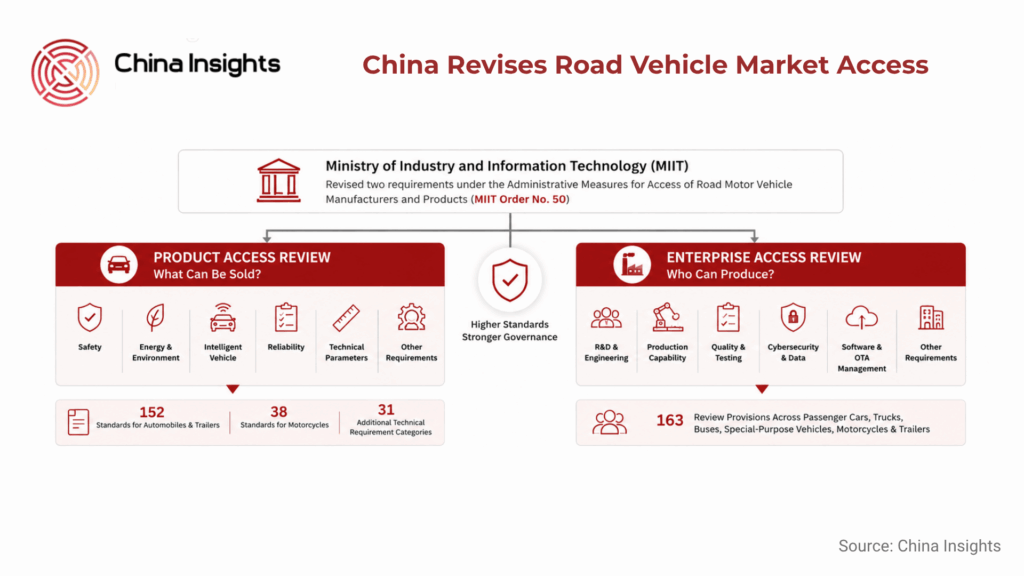
A comprehensive update of China’s vehicle approval framework
The two revised review requirements serve as implementing documents under China’s road motor vehicle access management system. Together they define the technical standards that vehicle products must satisfy and the organizational capabilities manufacturers must demonstrate before entering the Chinese market.
According to MIIT, the revisions are intended to address three broad objectives. First, they seek to support the automotive industry’s transition towards electrification, intelligence, and connectivity. Second, they integrate recent policy developments into a unified approval framework. Third, they strengthen product quality and enterprise responsibility to protect consumers better and public safety.
Product approval requirements become more demanding
The revised requirements update the definitions of six major vehicle categories and introduces formal definitions for Intelligent Connected Vehicles (ICVs) and Over-the-Air (OTA) software upgrades. Furthermore, technical standards have been updated. For automobiles and trailers, the revised requirements now reference 152 applicable standards, covering general safety, active safety, passive safety, energy efficiency, environmental protection, new energy vehicles, and intelligent connected vehicles. Motorcycle requirements have similarly been updated to include 38 technical standards across safety and environmental categories. Moreover, specialized vehicle categories, inspection procedures, vehicle parameters and trademark management expand as well. In total, the document introduces or updates 31 supplementary technical requirement categories.
Reliability becomes a formal approval requirement
Historically, reliability testing has been largely addressed through quality management practices and manufacturer validation programs. Under the revised framework, product reliability becomes an integral component of market access.
The revised requirements introduce mandatory reliability testing while strengthening rules covering dimensional tolerances, payload utilization coefficients, and technical performance verification. They also require additional evaluation when manufacturers apply new technologies, new materials, or new manufacturing processes.
For manufacturers, this raises the technical threshold for new product approval and reinforces the expectation that innovative technologies must demonstrate sufficient operational maturity before commercial deployment.
Intelligent vehicle regulation moves into the mainstream
The new product requirements include dedicated technical provisions covering intelligent connected vehicles and OTA software upgrades. Simultaneously, the manufacturer review requirements introduce corresponding obligations relating to cybersecurity, data security, software management, and product monitoring.
For passenger car manufacturers in particular, additional capability requirements now apply to companies developing vehicles equipped with combined driving assistance functions or autonomous driving capabilities. These include requirements covering organizational structures, engineering personnel, research and development procedures, and after-sales data management.
The revisions therefore move beyond traditional hardware regulation towards oversight of software-defined vehicles and their ongoing operational management.
Greater emphasis on enterprise capabilities
The revised Requirements for Entry Review of Road Motor Vehicle Manufacturing Enterprises maintain the existing overall structure but strengthen enterprise capability requirements.
The revised document contains 163 review provisions covering general requirements, production capabilities, and technical requirements across passenger cars, trucks, buses, special-purpose vehicles, motorcycles, and trailers.
Across vehicle categories, MIIT has updated requirements relating to research and development, manufacturing processes, inspection and testing, supplier management, quality assurance and production capability.
Furthermore, truck manufacturers face new review requirements for body modification enterprises and computerized information management systems. Special-purpose vehicle manufacturers must satisfy additional requirements relating to new energy vehicle chassis and specialized equipment reliability verification. Motorcycle manufacturers are expected to demonstrate expanded battery testing capabilities, including battery charging performance, endurance, and lifecycle testing.
A more integrated and standardized approval system
The product review requirements now include a dedicated chapter defining the concepts of “same model” and “same type,” providing greater clarity on how product variants will be assessed during approval reviews.
The documents also integrate existing management requirements relating to inspection procedures, trademark administration, intelligent connected vehicles, OTA management and the application of new technologies.
According to MIIT, this integration aims to improve consistency, increase regulatory transparency and make future product reviews more efficient while allowing technical parameters to evolve alongside industry development.
What this means for business
The revised approval requirements signal a continued shift in China’s automotive regulatory system from traditional manufacturing oversight towards comprehensive lifecycle governance of increasingly digital vehicles.
For vehicle manufacturers, regulatory compliance will require more than meeting technical specifications. Companies will also need to demonstrate mature organizational capabilities covering software development, cybersecurity, data governance, quality management, reliability validation, and after-sales monitoring.
Manufacturers introducing intelligent connected vehicles or advanced driver assistance technologies should expect greater scrutiny of development processes and operational safety. Meanwhile, suppliers and technology providers supporting vehicle software, testing, and validation are likely to benefit from increasing regulatory demand for specialized technical capabilities.
Although the new requirements do not fundamentally alter China’s vehicle access system, they raise the expectations placed on both products and manufacturers. Companies planning future investments or product launches in China should use the transition period before 1 January 2027 to review compliance strategies, strengthen internal capabilities, and prepare for a more demanding approval environment.
Sources
https://wap.miit.gov.cn/zwgk/zcjd/art/2026/art_09b175f25de1496f9f26b6cd791945f0.html
https://wap.miit.gov.cn/zwgk/zcjd/art/2026/art_8890ad38530a41fb8ea05100b84d935f.html
https://wap.miit.gov.cn/zwgk/zcjd/art/2026/art_b57e5927cbe5473c97712ba2529949ff.html
Author
Dr. Richard van Ostende

Related Articles