
China Strengthens Healthcare Insurance Fund Compliance Through New Five-Year Supervision Plan
On 13 May 2026, the National Healthcare Security Administration released the policy interpretation of the Medical Insurance Fund Supervision and Inspection Five-Year Action Plan (2026–2030) (医疗保障基金监督检查五年行动计划(2026年—2030年)). The plan outlines China’s strategic direction for strengthening supervision of the country’s medical insurance funds during the 15th Five-Year Plan period.
The initiative reflects growing concerns among Chinese authorities regarding fraud, abuse, and inefficiencies in the use of healthcare insurance funds. At the same time, it highlights Beijing’s broader efforts to modernize governance mechanisms through digitalization, cross-agency coordination, and risk-based supervision.
Executive Summary
- The plan aims to establish a comprehensive, multi-layered, and technology-driven supervision framework for healthcare insurance funds.
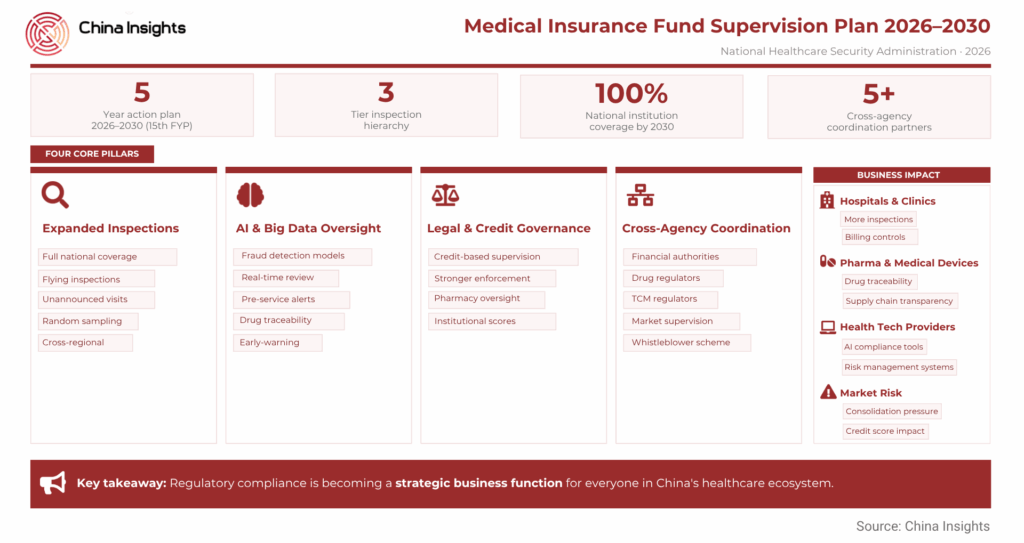
- Authorities will intensify nationwide inspections of hospitals, pharmacies, and healthcare institutions, including expanded “flying inspections” and cross-regional investigations.
- Artificial intelligence, big data analytics, and drug traceability systems will play a larger role in identifying fraudulent or irregular fund usage.
- China intends to strengthen legal frameworks, credit management systems, and inter- agency coordination mechanisms related to healthcare insurance supervision.
- The policy supports broader healthcare governance reforms and aims to improve market order within the healthcare and pharmaceutical sectors.

Background Behind the New Action Plan
According to the National Healthcare Security Administration, healthcare insurance funds represent critical social welfare resources and are directly linked to public wellbeing and social stability. Since the establishment of the national healthcare insurance administration system, authorities have developed inspection mechanisms and anti-fraud enforcement measures to reduce misuse of public healthcare funds. However, the regulator acknowledged that challenges remain significant. Fraudulent claims, abuse of reimbursement mechanisms, and irregular billing practices continue to occur. Authorities also noted that fraudulent schemes have become increasingly sophisticated, concealed, and professionalized.
At the same time, China’s healthcare insurance system has become more complex. Expanding insurance coverage, increasing reimbursement levels, and ongoing payment reform initiatives have introduced additional operational risks. The growing number of participating institutions and longer transaction chains have increased the difficulty of monitoring fund usage effectively.
Against this backdrop, the new five-year action plan was developed to provide a unified national framework for healthcare insurance fund supervision during the 2026–2030 period.
Expansion of Nationwide Inspection Mechanisms
A central pillar of the plan is the expansion of inspection coverage across China’s healthcare ecosystem. Authorities intend to strengthen the deterrence effect of inspections through more systematic and frequent supervisory activities. The plan emphasizes “full coverage” supervision across all regions, institution types, insurance categories, and healthcare scenarios. During the 2026–2030 period, regulators aim to complete on-site inspections of all designated medical and pharmaceutical institutions nationwide.
The inspection structure will operate through a three-tiered national, provincial, and local system. National-level inspections are expected to cover all provinces annually and all prefecture-level cities within five years. Provincial authorities will inspect all cities and counties within their jurisdictions over the same period.
The plan also introduces several new approaches. These include specialized inspections for long-term care insurance funds, joint military-civilian inspection mechanisms, increased use of targeted “point-based” inspections, combination of announced and unannounced investigations and integration of random sampling with direct investigations. This reflects a broader regulatory trend in China toward increasingly data-driven and risk-based enforcement practices.
Greater Use of Big Data and Artificial Intelligence
The action plan places significant emphasis on technological supervision tools. Chinese authorities intend to strengthen digital oversight capabilities by developing large-scale data monitoring systems and intelligent regulatory models.
The policy specifically highlights the creation of multi-dimensional big data supervision models focused on fraudulent reimbursement behavior, drug and medical consumables usage, diagnostic and treatment procedures, specific diseases and insurance categories and high-risk patient groups. Authorities aim to improve monitoring accuracy and early-warning capabilities through advanced analytics.
The plan also calls for the establishment of a full-process intelligent supervision system covering pre-service alerts at medical institutions, real-time review during reimbursement processing and post-service administrative supervision. This approach is intended to create layered defenses against irregular or fraudulent healthcare fund usage.
Importantly, the document explicitly references the future application of artificial intelligence technologies and drug traceability systems in healthcare insurance supervision. This aligns with China’s broader national strategy of integrating AI into public governance and regulatory systems.
Strengthening Long-Term Governance Mechanisms
Beyond enforcement activities, the action plan seeks to address structural weaknesses in healthcare insurance governance.
Authorities plan to strengthen legal and institutional frameworks related to healthcare insurance supervision. This includes improving administrative enforcement standards, enhancing supervision of retail pharmacies, and exploring dedicated regulatory mechanisms for long-term care insurance funds.
The policy also proposes the expansion of credit-based supervision systems covering medical institutions, healthcare professionals and insurance participants. Credit evaluations may increasingly influence regulatory treatment, incentives, and restrictions for healthcare sector participants.
Another important aspect is the strengthening of inter-agency coordination. The National Healthcare Security Administration intends to deepen cooperation with financial authorities, health commissions, traditional Chinese medicine regulators, market supervision authorities and drug regulators.
This reflects China’s broader “whole-of-government” approach to regulatory enforcement. The plan additionally highlights public participation mechanisms, including whistleblower systems and reporting reward schemes, as tools to strengthen social oversight.

Implications for China’s Healthcare and Pharmaceutical Sectors
The action plan is likely to have significant implications for hospitals, pharmaceutical companies, pharmacies, insurers, and healthcare technology providers operating in China.
For healthcare institutions, compliance expectations will continue to rise. Increased inspection frequency and broader use of data analytics may expose operational irregularities more rapidly than before. Institutions will likely face greater pressure to strengthen internal compliance systems, billing controls, and reimbursement procedures.
For pharmaceutical and medical device companies, the enhanced focus on drug traceability and usage monitoring could accelerate digital reporting and supply chain transparency requirements.
Healthcare technology providers may benefit from growing demand for AI-enabled compliance tools, risk management systems, and healthcare data analytics solutions.
The policy may also contribute to greater market consolidation over time. Smaller institutions with weaker compliance capabilities could face increasing operational pressure under stricter supervision standards.
At a macro level, the initiative supports China’s broader healthcare reform agenda by attempting to balance stricter fund security with continued sector development.
What This Means for Business
The Medical Insurance Fund Supervision and Inspection Five-Year Action Plan (2026–2030) signals that healthcare compliance and regulatory transparency will remain central priorities during China’s 15th Five-Year Plan period.
Companies operating in China’s healthcare ecosystem should expect more frequent inspections and audits, greater use of AI-driven monitoring tools, higher expectations regarding billing accuracy and documentation, increased cross-agency data sharing and stronger enforcement against fraudulent or non-compliant practices
For foreign and domestic healthcare stakeholders alike, regulatory compliance is increasingly becoming a strategic business function rather than solely an administrative requirement.
Source
https://www.nhsa.gov.cn/art/2026/5/13/art_14_16325.html
Author
Dr. Richard van Ostende

Related Articles