
China Strengthens Drug Trial Data Protection Rules for Innovative and Generic Medicines
On 15 May 2026, the National Medical Products Administration published a policy interpretation of the Measures for the Implementation of Pharmaceutical Trial Data Protection (《药品试验数据保护实施办法》). The document clarifies the scope and application of pharmaceutical trial data protection in China.
The measures form part of China’s broader effort to strengthen pharmaceutical intellectual property protection, support innovative drug development, and align regulatory practices more closely with international standards. The policy is particularly relevant for innovative drug developers, multinational pharmaceutical companies, biotechnology firms, and generic drug manufacturers active in China’s healthcare market.
Executive Summary
- The National Medical Products Administration released the policy interpretation of the Measures for the Implementation of Pharmaceutical Trial Data Protection on 15 May 2026.
- The framework clarifies the definitions of “undisclosed data,” “self-obtained data,” and “reliance” in the drug approval process.
- Protection applies to original trial data used to prove drug safety, efficacy, and quality.
- Certain innovative drugs and new indications may receive up to six years of data protection.
- Traditional Chinese Medicine remains outside the scope of the framework.
The measures support pharmaceutical innovation, synchronized global drug development, and domestic manufacturing.

Background of the Data Protection Framework
Pharmaceutical trial data protection prevents competing applicants from relying on protected clinical and testing data submitted by the original applicant during the approval process.
China has gradually expanded its pharmaceutical intellectual property framework as part of broader healthcare reform and innovation policies. The latest measures provide additional clarity on how the protection system will operate in practice and aim to encourage the development of original scientific data supporting drug safety and efficacy.
Clarification of Key Definitions
The policy interpretation clarifies several important regulatory concepts.
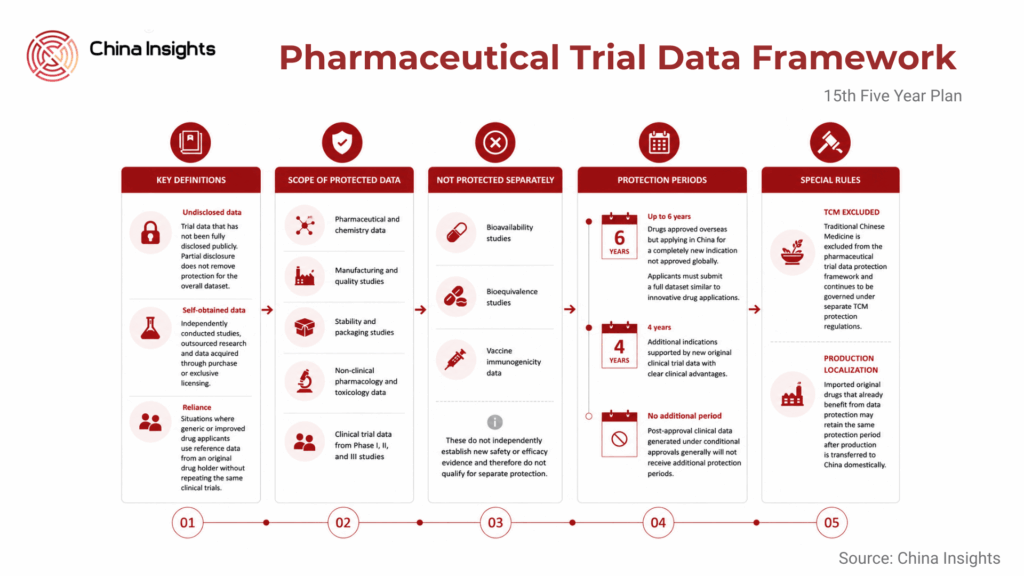
“Undisclosed data” refers to trial data that has not been fully disclosed publicly. Partial disclosure does not remove protection for the overall dataset.
“Self-obtained data” includes independently conducted studies, outsourced research and data acquired through purchase or exclusive licensing
The measures also clarify “reliance,” referring to situations where generic or improved drug applicants use reference data from an original drug holder without repeating the same clinical trials.
Scope of Protected Data
According to the National Medical Products Administration, protected data may include:
- Pharmaceutical and chemistry data
- Manufacturing and quality studies
- Stability and packaging studies
- Non-clinical pharmacology and toxicology data
- Clinical trial data from Phase I, II, and III studies
The framework focuses on protecting original data demonstrating safety, efficacy, and quality. However, the regulator clarified that bioavailability studies, bioequivalence studies, and vaccine immunogenicity data generally do not qualify for separate protection because they do not independently establish new safety or efficacy evidence.
Protection Periods for Innovative Drugs and New Indications
The measures establish different protection periods depending on the type of drug application. Drugs approved overseas but applying in China for a completely new indication not approved globally may receive six years of data protection. In such cases, applicants must submit a full dataset similar to innovative drug applications. Additional indications supported by new original clinical trial data may qualify for four years of protection if they demonstrate clear clinical advantages. The policy also states that post-approval clinical data generated under conditional approvals generally will not receive additional protection periods.
Traditional Chinese Medicine Excluded
Traditional Chinese Medicine is excluded from the pharmaceutical trial data protection framework and continues to be governed under separate TCM protection regulations. This reflects China’s continued distinction between TCM products and conventional pharmaceutical regulation.
Support for Domestic Manufacturing
The measures also encourage foreign pharmaceutical companies to localize manufacturing in China. Imported original drugs that already benefit from data protection may retain the same protection period after production is transferred to China domestically. The framework additionally simplifies certain approval requirements for generic drugs referencing overseas-approved original drugs that were previously unavailable in China. After the first approved generic has been marketed for two years, subsequent applicants may no longer need to repeat full clinical safety and efficacy studies.

Implications for China’s Pharmaceutical Sector
The measures further strengthen China’s innovation-oriented pharmaceutical regulatory framework. For innovative pharmaceutical and biotechnology companies, stronger data protection may support:
- Original drug R&D
- Simultaneous global clinical development
- Faster China market entry
- Domestic manufacturing investment
For generic drug manufacturers, the framework creates clearer rules regarding reliance on protected data and may increase barriers during exclusivity periods. The measures also support China’s broader objective of building a more innovation-driven pharmaceutical ecosystem while maintaining public healthcare access.
What This Means for Business
China’s updated pharmaceutical trial data protection framework signals continued strengthening of intellectual property protection in the life sciences sector.
Companies operating in pharmaceuticals, biotechnology, clinical research, and healthcare investment should expect:
- Greater emphasis on original clinical data
- Expanded protection for innovative drugs
- Clearer exclusivity rules for new indications
- Continued support for localized manufacturing
- More structured pathways for generic competition after protection periods expire
For multinational pharmaceutical companies, the framework may improve the attractiveness of China as a destination for innovative drug launches and clinical development. At the same time, generic drug manufacturers will need to monitor evolving exclusivity timelines and reliance restrictions closely when planning China market strategies.
Source
https://www.nmpa.gov.cn/xxgk/zhcjd/202605152208.html
Author
Dr. Richard van Ostende

Related Articles