
China Approves 15th Five-Year Urban Renewal Plan
On 15 May 2026, the State Council of the People’s Republic of China reviewed and approved the Urban Renewal 15th Five-Year Plan (《城市更新“十五五”规划》). The plan signals a further shift in China’s urban development strategy from large-scale expansion toward upgrading existing urban infrastructure, housing, and public services.
Urban renewal is positioned as a key driver of high-quality urban development, with a focus on improving livability, sustainability, resilience, and economic efficiency.
Executive Summary
- China is shifting from expansion-driven urbanization to upgrading existing urban assets.
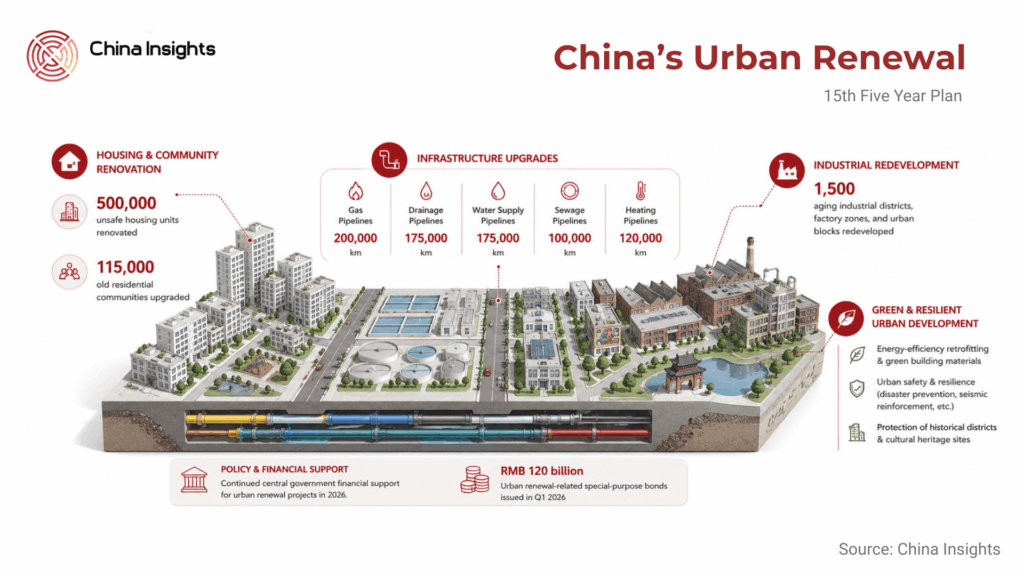
- The plan targets:
- Renovation of approximately 500,000 unsafe urban housing units
- Renovation of around 115,000 old residential communities
- Large-scale upgrades of gas, water, sewage, and heating pipeline networks
- Redevelopment of approximately 1,500 old industrial districts and urban blocks
- Key policy themes include green development, smart infrastructure, urban resilience, and cultural preservation.
- The plan is expected to create opportunities in infrastructure, construction, smart cities, green building materials, and urban services.

Infrastructure Upgrading Remains Central
A major component of the plan is the modernization of urban utility infrastructure. According to the 15th Five-Year Plan framework, China aims to upgrade:
- Approximately 200,000 km of gas pipelines
- 175,000 km of drainage pipelines
- 175,000 km of water supply pipelines
- 100,000 km of sewage pipelines
- 120,000 km of heating pipelines
Authorities also emphasized smart infrastructure upgrades and integrated underground utility corridors. These projects are expected to support demand for engineering, construction, digital monitoring systems, and urban infrastructure technologies.
Housing and Community Renovation Accelerates
The plan places strong emphasis on improving living conditions in older urban areas. Authorities aim to renovate approximately 500,000 unsafe or dilapidated housing units, particularly Class C and D dangerous housing on state-owned land.
In addition, around 115,000 old residential communities are expected to undergo renovation. Policy priorities include elevator installation, elderly care and childcare facilities, parking infrastructure, community-level public services and pocket parks and urban greenways. The objective is to improve urban living standards while supporting broader social and consumption-related policy goals.
Industrial Redevelopment and New Growth Drivers
China also plans to redevelop approximately 1,500 aging industrial districts, factory zones, and urban blocks. Authorities encourage market-oriented redevelopment of underutilized industrial facilities into innovation parks, cultural and creative zones, commercial mixed-use developments and startup and service-oriented districts. The policy reflects growing integration between urban renewal and industrial upgrading.
Green and Resilient Urban Development
Green and low-carbon development remain core policy priorities. Urban renewal projects increasingly incorporate energy-efficiency retrofitting, green building materials, sustainable urban infrastructure and low-carbon urban planning
The plan also emphasizes urban safety and resilience, including renovation or demolition of dangerous buildings, seismic reinforcement projects and improved disaster prevention capabilities In parallel, authorities reiterated the importance of protecting historical districts and cultural heritage sites, maintaining the principle that “old cities should no longer be demolished indiscriminately.”

Policy Support Expands
Several ministries have already introduced supporting measures for urban renewal implementation. In January 2026, the Ministry of Natural Resources and the Ministry of Housing and Urban-Rural Development jointly issued the Notice on Several Measures to Further Support Urban Renewal Actions (《关于进一步支持城市更新行动若干措施的通知》), introducing greater planning flexibility and policy support measures.
The Ministry of Finance and the Ministry of Housing and Urban-Rural Development also confirmed continued central government financial support for urban renewal projects in 2026. Urban renewal-related special-purpose bond issuance approached RMB 120 billion during the first quarter of 2026.
What This Means for Business
China’s Urban Renewal 15th Five-Year Plan highlights urban redevelopment as a long-term economic and policy priority.
The plan is expected to create opportunities across construction and engineering, smart city technologies, green building materials, urban infrastructure management, property redevelopment and public and community services
At the same time, implementation will remain highly localized and policy driven. Companies active in China’s urban renewal market will need to closely monitor provincial and municipal policy developments, financing tools, and public-private cooperation mechanisms.
Source
https://www.gov.cn/zhengce/202605/content_7069039.htm
Author
Dr. Richard van Ostende

Related Articles