
China Advances New Implementation Regulation for Mineral Resources Law
On 9 May 2026, the Chinese State Council reviewed and approved the draft Implementation Regulation of the Mineral Resources Law of the People’s Republic of China (《中华人民共和国矿产资源法实施条例(草案)》). The draft regulation serves as a key supporting framework for the revised Mineral Resources Law of the People’s Republic of China, which entered into force in July 2025.
The new regulation reflects Beijing’s broader efforts to strengthen resource security, improve governance of strategic minerals, enhance environmental protection standards, and modernize China’s mining sector. The initiative comes at a time when mineral resource security has become increasingly linked to industrial policy, energy transition strategies, and geopolitical competition over critical raw materials.
Executive Summary
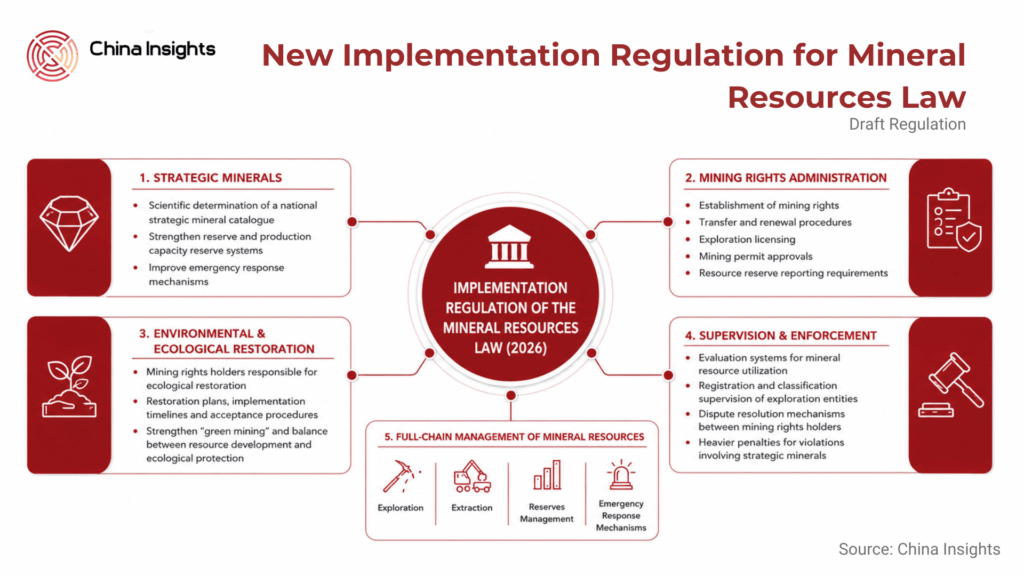
- China aims to strengthen full-chain management of mineral resources, including exploration, extraction, reserves management, and emergency response mechanisms.
- Strategic minerals and national resource security are central priorities under the new framework.
- The regulation introduces more detailed rules for mining rights management, ecological restoration responsibilities, and supervision mechanisms.
- The policy aligns with China’s broader goals related to industrial security, supply chain resilience, and green development.

Background of the Revised Mineral Resources Framework
China revised the Mineral Resources Law of the People’s Republic of China in November 2024, marking the first major overhaul of the legislation since its original adoption in 1986. The revised law entered into force on 1 July 2025 and introduced a significantly updated governance framework for mineral resource management.
The law was developed against the backdrop of rising global competition for strategic minerals and increasing concerns regarding supply chain resilience. China’s leadership has repeatedly emphasized the importance of resource security as part of the country’s broader national security strategy.
The implementation regulation approved by the State Council is intended to operationalize the revised law by providing more detailed administrative and enforcement provisions covering mining rights, exploration standards, ecological restoration obligations, strategic reserves management, and supervision procedures. The authorities aim to strengthen “full-chain management” of mineral resources and improve the country’s strategic resource security framework.
Strategic Minerals Become a Central Policy Focus
One of the most important themes emerging from the revised legal framework is the increasing emphasis on strategic minerals.
Chinese authorities have indicated that the regulation will support the scientific determination of a national strategic mineral catalogue and strengthen reserve and emergency response systems. This reflects China’s growing focus on securing long-term access to minerals that are considered critical for advanced manufacturing, defense, semiconductors, renewable energy, and emerging technologies.
The revised Mineral Resources Law already introduced a dedicated framework for strategic mineral protection. It established mechanisms for strategic mineral reserves, production capacity reserves, and emergency resource management.
The implementation regulation further reinforces this direction by introducing more detailed management measures related to exploration, extraction, and strategic reserve systems. This policy direction is consistent with broader industrial policy trends in China, where resource security is increasingly integrated into national development planning and technological self-sufficiency objectives.
Greater Regulation of Mining Rights and Resource Development
The regulation also introduces more detailed provisions concerning mining rights administration.
According to official reports, the regulation clarifies rules related to:
- Establishment of mining rights
- Transfer and renewal procedures
- Exploration licensing
- Mining permit approvals
- Resource reserve reporting requirements
Authorities are seeking to create a more standardized and transparent administrative framework for the mining sector.
The regulation additionally emphasizes the importance of improving the efficiency and comprehensive utilization of mineral resources. This suggests continued policy pressure on mining companies to optimize extraction practices, improve resource recovery rates, and reduce waste. The revised framework may also increase compliance obligations for both domestic and foreign mining operators active in China.
Stronger Environmental and Ecological Restoration Requirements
Environmental governance forms another key component of the new implementation framework.
The regulation reportedly clarifies that mining rights holders are responsible for ecological restoration activities in mining areas. It also specifies requirements concerning restoration plans, implementation timelines, and acceptance procedures. This reflects China’s broader regulatory trend toward integrating environmental protection requirements more deeply into industrial and resource governance systems.
In recent years, Chinese authorities have increasingly emphasized the concept of “green mining” and the balance between resource development and ecological protection. The implementation regulation appears to strengthen the legal basis for enforcing these objectives.
Mining operators may therefore face growing scrutiny regarding land rehabilitation, environmental remediation, and sustainable operational practices.

Enhanced Supervision and Enforcement Mechanisms
The regulation also introduces expanded supervision and enforcement mechanisms.
According to official summaries, authorities will strengthen:
- Evaluation systems for mineral resource utilization
- Registration and classification supervision of exploration entities
- Dispute resolution mechanisms between mining rights holders
- Penalties related to strategic mineral violations
Particularly notable is the indication that violations involving strategic minerals may face heavier penalties within the legal punishment framework. This highlights the increasingly sensitive political and economic importance of strategic resource management in China.
The regulation also reflects a broader trend toward more centralized and coordinated oversight of sectors considered critical to national security and industrial resilience.
Implications for Domestic and Foreign Companies
The revised implementation framework is likely to have significant implications for mining companies, industrial manufacturers, commodity traders, and foreign investors operating in sectors linked to mineral resources.
For mining operators, regulatory compliance requirements are expected to become more detailed and stringent. Companies may need to strengthen internal governance systems related to licensing, reporting, environmental management, and ecological restoration.
For industries dependent on strategic minerals including electric vehicles, semiconductors, renewable energy equipment, and advanced manufacturing, the policy reinforces the importance of resource security within China’s industrial strategy.
Foreign companies operating in China’s mining and industrial sectors may also encounter a more regulated operating environment, particularly in areas involving strategic resources and critical supply chains.
At the same time, the clearer legal framework may improve regulatory predictability in certain areas of mining rights administration and sector governance.
What This Means for Business
China’s new Implementation Regulation of the Mineral Resources Law signals a continued shift toward tighter state oversight of strategic resources, stronger environmental governance, and more sophisticated resource security management.
Businesses operating in mining, industrial manufacturing, energy transition technologies, and strategic supply chains should expect:
- Greater regulatory scrutiny of mineral resource activities
- Increased compliance obligations related to licensing and reporting
- Stronger environmental and ecological restoration requirements
- Expanded oversight of strategic mineral activities
- Closer alignment between resource governance and national security priorities
The regulation also highlights how mineral resources are becoming increasingly central to China’s broader economic security and industrial modernization agenda.
Companies with exposure to China’s mineral resource ecosystem may therefore need to strengthen regulatory monitoring, compliance management, and long-term supply chain risk assessment capabilities.
Source
https://www.gov.cn/yaowen/liebiao/202605/content_7025198.htm
Author
Dr. Richard van Ostende

Related Articles