
China Completes Allocation of RMB 200 Billion for Equipment Upgrades
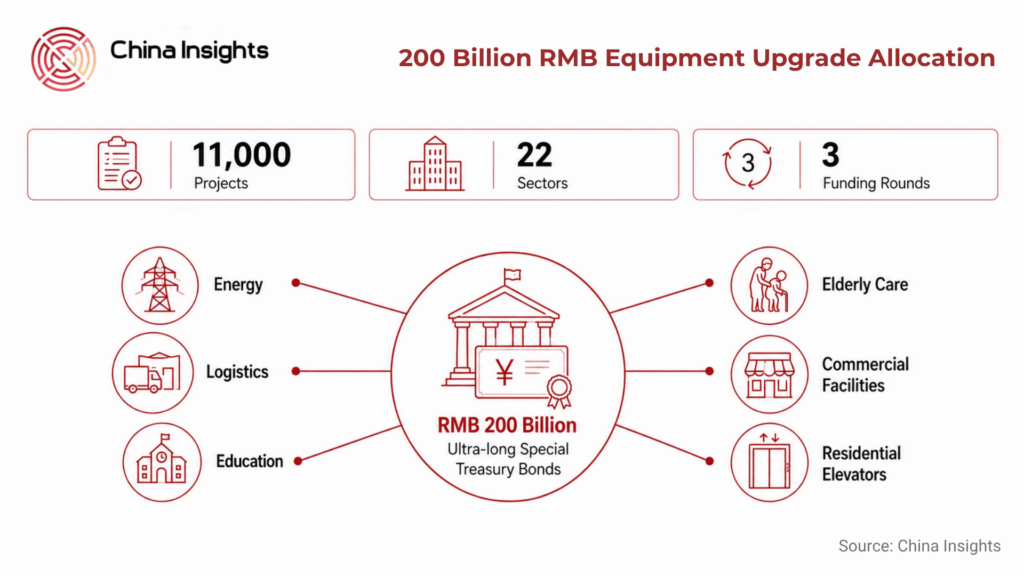
China has completed the allocation of RMB 200 billion (approximately USD 28 billion) in ultra-long special treasury bond funding to support equipment upgrades under its 2026 “Two New” (两新) policy. The funding supports around 11,000 projects across 22 sectors and marks the completion of the government’s three-round funding allocation process for this year.
Executive Summary
- The National Development and Reform Commission (NDRC) announced the completion of the third and final funding allocation in early July 2026.
- The 2026 program allocates RMB 200 billion in ultra-long special treasury bonds for equipment renewal.
- Approximately 11,000 projects across 22 sectors will receive financial support.
- Newly supported areas include elderly care institutions, commercial facilities, residential elevator replacement, community elevator installation and logistics infrastructure.
- The program forms part of China’s broader “Two New” policy aimed at accelerating industrial upgrading and stimulating domestic investment.
- The government will now shift its focus from funding allocation to project implementation and oversight.

Government completes annual funding allocation
The National Development and Reform Commission (NDRC) announced in early July 2026 that it has completed the allocation of the full RMB 200 billion earmarked for equipment upgrades under the 2026 “Two New” policy. The announcement followed the release of the third batch of approved projects and funding arrangements.
The funding is provided through ultra-long special treasury bonds, continuing the financing mechanism introduced by the central government to support strategic investment priorities. According to the NDRC, the annual allocation has been distributed through three funding rounds during the first half of 2026.
Expansion of supported sectors
The latest funding round broadens the scope of China’s equipment renewal program.
Projects receiving support include:
- Energy and power infrastructure
- Logistics facilities
- Educational institutions
- Elderly care institutions
- Offline commercial facilities
- Replacement of ageing commercial vehicles
- Replacement of ageing residential elevators
- Installation of elevators in older residential communities
Compared with earlier rounds, the inclusion of more public service and consumer-facing sectors demonstrates that the program extends beyond manufacturing and industrial upgrading. It increasingly supports infrastructure that improves service quality, public safety and domestic consumption.
The NDRC stated that the program now covers 22 sectors, making it one of the largest investment support initiatives under the current “Two New” policy framework.
Supporting industrial upgrading
Although the program includes public service projects, industrial modernization remains its primary objective. Equipment renewal is intended to increase productivity, improve energy efficiency and accelerate the replacement of outdated production assets. These objectives align with China’s broader industrial policy priorities, including advanced manufacturing, green development and technological upgrading. The central government also views equipment investment as an important tool for supporting fixed asset investment during a period of moderate economic growth. According to official data, investment in equipment and machinery purchases increased 9.3% year-on-year during January-May 2026, representing 17.5% of total investment, an increase of 2.2 percentage points compared with the same period last year.
From policy announcement to project delivery
With all funding now allocated, the government’s attention shifts to project implementation. The NDRC stated that it will work with relevant government departments to supervise project execution, strengthen whole-process management and accelerate construction progress. The objective is to ensure that approved projects generate tangible investment activity and that central government funding is used efficiently. This implementation phase will likely receive greater policy attention during the second half of 2026 as authorities seek to translate approved investment into measurable economic activity. The emphasis on closed-loop project management also reflects Beijing’s continued focus on improving the effectiveness of fiscal stimulus and reducing implementation delays.

Position within the “Two New” policy
The equipment renewal program forms one pillar of China’s broader “Two New” initiative, officially known as promoting large-scale equipment renewal and consumer goods trade-in programs. Rather than relying solely on broad fiscal stimulus, the policy targets investment that can simultaneously improve industrial competitiveness, encourage technological upgrading and stimulate domestic demand. Using ultra-long special treasury bonds allows the central government to finance these investments while spreading repayment obligations over an extended period. This financing mechanism has become an increasingly important component of China’s macroeconomic policy toolkit. The completion of this year’s funding allocation indicates that implementation remains on schedule and that the central government continues to prioritize targeted investment over broad-based stimulus measures.
What this means for business
The completion of the 2026 funding allocation provides greater visibility for companies participating in China’s equipment renewal program.
Manufacturers of industrial equipment, energy technologies, logistics systems, elevators, commercial infrastructure and related engineering services are likely to benefit as approved projects move into implementation.
Foreign companies operating in China should monitor procurement opportunities linked to approved projects, particularly where advanced equipment, automation technologies or energy-efficient solutions are required. However, participation will continue to depend on sector-specific procurement rules and local implementation practices.
The program also signals that Beijing remains committed to using targeted industrial investment to support economic growth. Rather than introducing broad stimulus measures, policymakers continue to channel fiscal resources toward projects that align with long-term industrial upgrading, green development and productivity improvements.
Source
https://www.gov.cn/zhengce/202607/content_7074269.htm
Author
Dr. Richard van Ostende

Related Articles