
China Launches Five-Year Plan to Standardize Service Trade Development
China has taken another step toward strengthening its service trade sector with the release of a new national action plan focused on standardization. On 23 April 2026, the Ministry of Commerce (MOFCOM) and the State Administration for Market Regulation (SAMR) jointly issued the Action Plan for Standardization of Trade in Services (2026–2030). The policy aims to establish a more comprehensive standards framework for China’s service trade industry and support the country’s broader agenda of high-quality development and institutional opening-up.
The policy underscores China’s commitment to strengthening the rules and standards governing service trade, with potential implications for competitiveness, market access, and operational requirements. Companies with exposure to China’s service economy should closely follow future sector-specific standards and implementation measures.
Executive Summary
China aims to establish a service trade standards system covering multiple sectors and the entire service trade value chain by 2030.
The plan focuses on improving standard supply, promoting innovation, enhancing international cooperation, and strengthening implementation mechanisms.
Authorities intend to increase China’s participation in international standard-setting activities related to service trade.
The initiative supports China’s broader objective of promoting institutional opening-up through rules, regulations, management practices, and standards.
Why China Is Prioritizing Service Trade Standardization
According to the Ministry of Commerce, standards are increasingly viewed as an important tool for supporting technological innovation, industrial upgrading, and international trade. While standards have traditionally been associated with manufacturing industries, Chinese policymakers argue that they are equally important for services due to the sector’s intangible nature, diverse delivery methods, and regulatory complexity.
The policy interpretation notes that Beijing has repeatedly emphasized the importance of improving service trade standardization. References are made to the National Standardization Development Outline released in 2021, as well as subsequent policy directives promoting institutional opening-up and high-quality development of service trade.
Against this backdrop, the new action plan seeks to establish a stronger standards foundation for China’s growing service economy and to support cross-border service transactions through greater consistency and transparency.
Building a National Service Trade Standards System
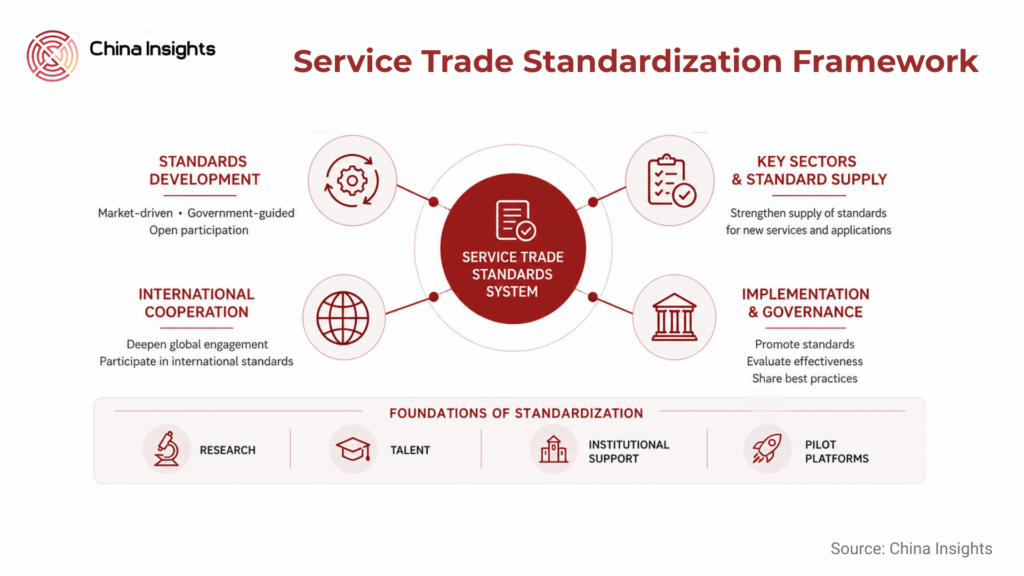
One of the central objectives of the action plan is the creation of a service trade standards system that is aligned with China’s development needs over the coming five years.
The plan calls for a combination of market-driven and government-guided approaches. Authorities intend to optimize the supply of standards while encouraging participation from a wide range of stakeholders, including industry associations, enterprises, and technical organizations. The policy also highlights the importance of open collaboration and information sharing in the development of standards.
In addition to creating new standards, the government plans to strengthen implementation, evaluation, and promotion mechanisms. This reflects a broader effort to ensure that standards are not only developed but also effectively adopted across industries.
Expanding Standards in Key Service Trade Sectors
The action plan places significant emphasis on increasing the supply of standards in priority service trade sectors.
The focus on key sectors suggests that policymakers view standards as a mechanism for supporting innovation, improving service quality, and facilitating international market access. As new technologies and business models emerge, the government intends to accelerate the development and revision of standards that can accommodate new service offerings and application scenarios.
Promoting International Standardization Cooperation
Another major component of the plan is the internationalization of service trade standards.
Chinese authorities intend to deepen international exchanges and cooperation while increasing participation in the development of international standards. The plan also highlights efforts to strengthen China’s role within international standardization organizations and governance frameworks.
This objective aligns with China’s broader strategy of increasing its influence in global economic governance and shaping international rules in emerging sectors. For service exporters, greater alignment between domestic and international standards could potentially reduce barriers to cross-border business activities and improve interoperability across markets.
Strengthening the Foundations of Standardization
Beyond the development of standards themselves, the action plan includes measures designed to strengthen the underlying infrastructure supporting standardization work.
These efforts include expanding research activities, enhancing institutional support mechanisms, strengthening professional talent development, and establishing pilot platforms for testing and implementing standards-related initiatives.
The policy recognizes that effective standardization requires more than technical documents. It also depends on the availability of qualified professionals, research capabilities, implementation frameworks, and institutional coordination across different levels of government and industry.
What This Means for Business
This new Action Plan indicates that standardization will become an increasingly important component of China’s service trade development strategy over the coming years.
For businesses operating in sectors such as digital services, professional services, technology-enabled services, and cross-border service delivery, the initiative may create new compliance requirements as additional standards are introduced. At the same time, greater standardization could improve market transparency, facilitate international transactions, and support the development of more predictable operating environments.
Companies involved in service exports, international partnerships, and standards-related activities should monitor future announcements regarding specific sector standards, implementation guidelines, and opportunities to participate in standard-setting initiatives. The policy also suggests that firms with expertise in standards development, certification, training, and compliance may benefit from increased demand as China expands its service trade standardization framework.
Source
https://www.gov.cn/zhengce/202604/content_7066810.htm
Author
Dr. Richard van Ostende

Related Articles