
China’s Electricity Consumption Grows 6.1% in Early 2026: Signals of Industrial Stabilization and Structural Shift
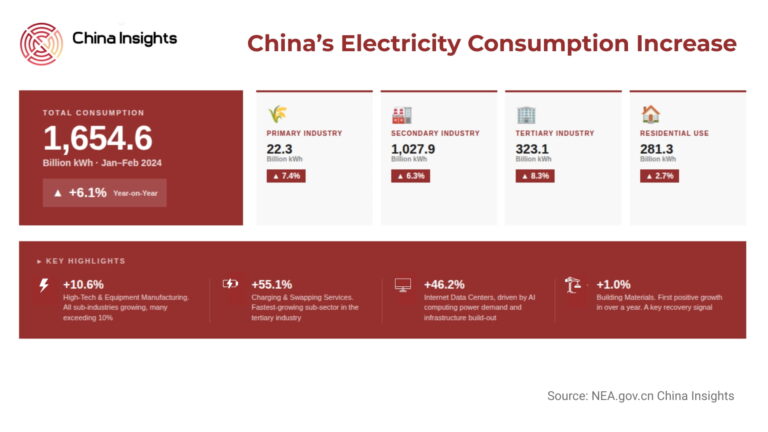
China’s electricity consumption is widely regarded as a key proxy for real economic activity, offering timely insights into industrial output, service sector expansion, and overall economic momentum. In a recent update, the National Energy Administration reported that total electricity consumption across society increased by 6.1% year-on-year in January–February 2026. The data, published via the central government platform, provides an early indication of economic trends at the start of the year and highlights both cyclical recovery and structural transformation within the Chinese economy.
For international businesses operating in China, this means steady electricity consumption growth signals a stable industrial environment while reflecting a broader structural shift toward service-oriented and digital sectors, creating opportunities for companies aligned with these emerging demand drivers. Regional variation in energy trends underscores the importance of location-specific strategies, and businesses that treat electricity data as a leading indicator for market demand and production planning will be better positioned to navigate China’s ongoing economic transformation.
Executive Summary
- China’s total electricity consumption grew by 6.1% year-on-year in January–February 2026.
- Industrial electricity usage remains a key growth driver, reflecting stabilization in manufacturing activity.
- The tertiary sector continues to show steady expansion, supporting consumption-led growth.
- Regional and sectoral differences indicate ongoing structural economic shifts.
- The figures provide a leading indicator for broader economic performance in Q1 2026.

Policy Release and Data Overview
On the official platform of the Chinese central government, the National Energy Administration published “2026年1至2月份全社会用电量同比增长6.1%” (Total Electricity Consumption Increased by 6.1% Year-on-Year in January–February 2026). While the exact publication date is not always explicitly highlighted in summary releases, such monthly data updates are typically issued in March 2026.
The report indicates that total electricity consumption reached a level consistent with moderate economic expansion. As electricity usage is closely tied to industrial production and service activity, the growth rate suggests that China’s economy has maintained a stable start to the year despite external uncertainties.
Industrial Sector as a Core Growth Driver
Electricity consumption in the secondary sector, particularly manufacturing and heavy industry, remains a primary contributor to overall growth. The 6.1% increase reflects ongoing stabilization in industrial output following periods of volatility in previous years.
Key industries such as equipment manufacturing, high-tech production, and export-oriented sectors have likely contributed to this trend. Increased electricity demand in these areas signals improved capacity utilization and a gradual recovery in both domestic and external demand.
At the same time, energy-intensive industries may exhibit more moderate growth due to policy constraints related to environmental targets and efficiency improvements. This indicates a balancing act between economic growth and sustainability objectives.
Expansion of the Service Economy
The tertiary sector continues to play an increasingly important role in China’s electricity consumption profile. Growth in services, including digital infrastructure, logistics, retail, and commercial real estate, has contributed to rising power demand.
This trend aligns with China’s long-term economic transition toward a more consumption- and service-driven model. Compared to traditional manufacturing, service sector electricity usage tends to be less energy-intensive but more stable, providing a consistent baseline for overall demand growth.
The expansion of data centers and digital services is particularly noteworthy, as these segments are becoming significant contributors to electricity consumption.
Residential Consumption and Seasonal Factors
Electricity usage in the residential sector also contributes to overall demand, particularly during the winter months. Heating needs, combined with increased household consumption during the Lunar New Year period, typically drive seasonal spikes in electricity use during January and February.
However, residential consumption growth is generally more stable and less volatile than industrial demand. While it supports overall growth figures, it is not the primary driver of year-on-year changes at the macro level.

Regional Variations and Economic Implications
China’s electricity consumption growth is not uniform across regions. Coastal provinces with strong industrial bases and export-oriented economies tend to exhibit higher growth rates, reflecting stronger economic activity.
In contrast, some inland regions may experience slower growth, depending on local industrial structures and investment levels. However, targeted policy support and infrastructure development continue to promote more balanced regional growth over time.
These regional differences provide valuable insights for businesses assessing market opportunities and supply chain strategies within China.
Structural Transformation and Energy Efficiency
The latest electricity consumption data also highlights ongoing structural changes in China’s economy. As the country moves toward higher value-added industries and greener growth, the relationship between electricity consumption and GDP growth is evolving.
Energy efficiency improvements, driven by regulatory measures and technological innovation, are helping to moderate electricity demand growth relative to economic output. This reflects China’s commitment to carbon peaking and carbon neutrality goals.
At the same time, the electrification of industries, such as electric vehicles and renewable energy integration, may increase electricity demand in certain sectors, offsetting efficiency gains.
Electricity Consumption as a Leading Indicator
Electricity consumption is often used as a leading indicator for economic performance in China. The 6.1% growth rate suggests a stable economic trajectory in the early months of 2026, providing a positive signal for first-quarter GDP performance.
However, it is important to interpret the data in context. External factors such as global demand, trade dynamics, and geopolitical developments continue to influence China’s economic outlook. As such, electricity consumption should be analyzed alongside other indicators, including industrial production, retail sales, and fixed asset investment.
What This Means for Business
The latest electricity consumption data provides several actionable insights for businesses operating in or engaging with China:
The steady growth rate indicates a stable operating environment, particularly in industrial and manufacturing sectors
Companies in energy-intensive industries should continue to monitor efficiency and regulatory requirements
Opportunities are expanding in service-oriented and digital sectors, driven by rising electricity demand
Regional differences highlight the importance of location-specific strategies for investment and operations
Electricity consumption trends can serve as an early signal for market demand and production planning
Overall, the data reinforces the view that China’s economy is maintaining steady momentum while undergoing structural transformation. Businesses that align with these trends, particularly in high-value and sustainable sectors, are likely to be better positioned for long-term growth.
Sources
https://www.news.cn/20260317/c98a55b1c8f045cf99b06e854f3428fd/c.html
https://www.stdaily.com/web/gdxw/2026-03/17/content_486780.html
https://finance.sina.com.cn/money/bond/2026-03-17/doc-inhrhttq2131270.shtml
https://www.news.cn/20260317/c3356bbfd24d496db30d82eac7cf64dc/c.html
Author
Dr. Richard van Ostende

Related Articles