
China Prioritizes Infrastructure Investment, Environmental Standards, and Bidding Reform in 2026 Policy Discussions
According to a report published on 2 March 2026 by the State Council of the People’s Republic of China on the official government website, senior government leaders held policy discussions focusing on investment promotion, infrastructure development, environmental governance, and regulatory reform. These discussions form part of the broader policy agenda shaping China’s economic and industrial strategy in the early stage of the 15th Five-Year Plan period (2026–2030).
The report highlights several areas where the central government intends to strengthen policy implementation, including the promotion of effective investment, improvements to environmental standards, and reforms to public procurement and bidding systems. Together, these initiatives illustrate how Chinese authorities are using policy coordination to support economic stability while advancing structural reforms.
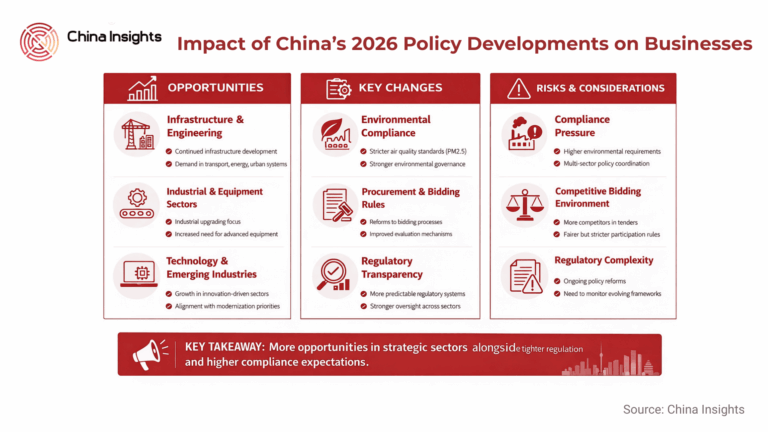
For international businesses operating in China, this means continued government emphasis on infrastructure investment and strategic industrial sectors will sustain opportunities in engineering, technology, and industrial equipment, while ongoing regulatory modernization requires close monitoring of evolving environmental compliance standards. Proposed reforms to procurement and tendering frameworks may also reshape how companies compete for government contracts, making it essential to stay ahead of policy developments across both regulatory and market access dimensions.
Executive Summary
- A policy report published on 2 March 2026 by the State Council of the People’s Republic of China outlined key policy discussions related to economic development and regulatory reform.
- The meeting focused on promoting effective investment, strengthening environmental governance, and advancing regulatory modernization.
- Authorities emphasized the importance of using central budget investment, special government bonds, and policy finance tools to support infrastructure and development projects.
- The government also discussed revisions to the Environmental Air Quality Standards and reforms to the Bidding and Tendering Law of the People’s Republic of China.
- Policymakers highlighted the role of major infrastructure projects and emerging industries in strengthening China’s long-term economic competitiveness.
- The discussions indicate continued policy focus on high-quality development, investment efficiency, and regulatory transparency.

Promoting Effective Investment
One of the central topics addressed during the policy discussions was the importance of promoting effective investment to support economic growth and strengthen long-term development capacity.
Chinese policymakers emphasized that investment remains a critical driver of economic activity, particularly in sectors linked to infrastructure modernization, industrial upgrading, and public services. Authorities highlighted the need to use available fiscal and financial instruments more efficiently to support high-impact projects.
The policy discussion referenced several financing tools used by the government to support investment. These include central budget investment funds, ultra-long-term special treasury bonds, and local government special bonds. By combining these instruments with policy finance initiatives, the government aims to mobilize both public and private capital for strategic development projects.
Officials also emphasized the importance of encouraging private sector participation in investment projects. Strengthening private investment is viewed as an important mechanism for improving resource allocation efficiency and enhancing the sustainability of economic growth.
Strategic Infrastructure and Major Development Projects
The policy discussions highlighted the role of major infrastructure and development projects in supporting China’s long-term economic competitiveness.
Authorities indicated that future investment initiatives should align with broader national development strategies, including the formulation of the 15th Five-Year Plan (2026–2030). This means that infrastructure investment will increasingly focus on projects that contribute to technological innovation, industrial upgrading, and the development of emerging industries.
In practical terms, this approach may involve expanding investment in areas such as transportation networks, urban infrastructure modernization, energy systems, and digital infrastructure. By focusing on strategic sectors, the government aims to strengthen the foundations of long-term economic growth while improving the efficiency of public investment.
At the same time, policymakers stressed the importance of ensuring that investment projects contribute to regional development and improved public services.
Strengthening Environmental Governance
Environmental policy also featured prominently in the policy discussions. Authorities reviewed proposals to revise the Environmental Air Quality Standards, which define the regulatory framework for monitoring and managing air pollution in China.
The revised standards aim to set stricter targets for annual average concentrations of fine particulate matter (PM2.5), reflecting the government’s continued commitment to improving environmental quality and public health.
Policymakers emphasized that achieving these objectives will require coordinated policy support across multiple sectors, including fiscal policy, technological innovation, and regional environmental management. The government also highlighted the importance of strengthening joint prevention and control mechanisms for pollution in key regions.
The revision of environmental standards reflects China’s broader strategy of integrating environmental protection into economic development policies, supporting the transition toward greener growth.
Reforming the Public Procurement and Bidding System
Another key policy topic discussed during the meeting was the proposed revision of the Bidding and Tendering Law of the People’s Republic of China.
According to the policy discussion, the proposed reform aims to improve transparency in the bidding process, strengthen regulatory oversight, and eliminate hidden barriers to market participation. Authorities also emphasized the importance of improving evaluation mechanisms and strengthening enforcement against illegal activities in the procurement process.
These reforms are part of a broader effort to improve the functioning of China’s public procurement system and ensure fair competition among market participants.
Regulatory Modernization and Market Governance
The policy discussions also reflect China’s broader effort to modernize its regulatory framework and improve market governance.
Chinese authorities have increasingly emphasized the importance of creating transparent and predictable regulatory systems that support economic development while ensuring fair competition. Reforms to procurement regulations, environmental standards, and investment policies are therefore part of a broader strategy to improve the institutional foundations of the Chinese market economy.
At the same time, policymakers continue to balance regulatory modernization with the government’s strategic development objectives, ensuring that regulatory reforms support broader national priorities such as industrial upgrading and environmental protection.

Policy Coordination in a Changing Economic Environment
China’s economic policy environment is evolving in response to structural changes in the domestic and global economy. Policymakers are increasingly focused on improving economic resilience while promoting higher-quality growth.
The policy discussions reflected the government’s intention to strengthen coordination between different policy tools, including fiscal policy, financial policy, industrial policy, and environmental regulation.
This integrated approach aims to ensure that economic policy supports sustainable development while maintaining macroeconomic stability.
What This Means for Business
For businesses operating in China or engaging with Chinese markets, the policy discussions reported by the State Council provide several important signals.
- The continued emphasis on effective investment and infrastructure development suggests ongoing opportunities in sectors related to infrastructure, engineering, technology, and industrial equipment.
- The focus on major development projects and emerging industries indicates that China will continue prioritizing strategic sectors aligned with technological innovation and industrial modernization.
- The revision of environmental standards and regulatory frameworks suggests that companies should closely monitor evolving environmental compliance requirements, particularly in industries with significant environmental impact.
- The proposed reforms to the Bidding and Tendering Law could lead to changes in how companies participate in government procurement and public project bidding.
Overall, the policy signals emerging from the State Council discussions indicate that China will continue pursuing a development strategy focused on investment efficiency, regulatory modernization, and high-quality economic growth.
Sources
- State Council Policy Discussion Report
https://www.gov.cn/lianbo/202603/content_7062281.htm - State Council Policy Report (China Government Network)
https://www.gov.cn/lianbo/202603/content_7062281.htm - People’s Daily / Xinhua summary of State Council executive meeting
https://www.gjbmj.gov.cn/n1/2026/0209/c409080-40661999.html
Author
Dr. Richard van Ostende

Related Articles