
China’s Aviation Industry Enters New Growth Phase in 2025
China’s Civil Aviation Industry Reaches New Highs in 2025
China’s civil aviation industry continued its post-pandemic expansion in 2025, supported by recovering international connectivity, sustained infrastructure investment, and rapid growth in the low-altitude economy. On 17 April 2026, the Civil Aviation Administration of China (CAAC) released the Statistical Bulletin of Civil Aviation Industry Development in 2025 (2025年民航行业发展统计公报), providing a comprehensive overview of sector performance across passenger transport, cargo, airport infrastructure, aviation safety, and drone development.
The report indicates that China’s aviation sector not only surpassed previous operational records but also entered a new phase of structural transformation driven by policy support for technological innovation, low-altitude aviation, and domestic aircraft manufacturing. The bulletin also reflects the strategic role of aviation in China’s broader economic modernization agenda during the final year of the 14th Five-Year Plan period.
Executive Summary
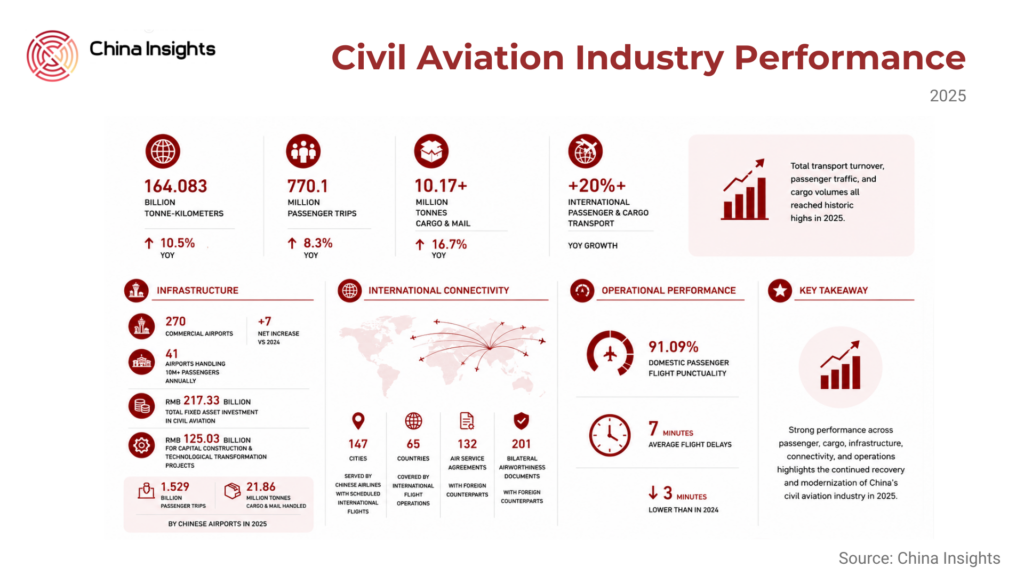
- China’s civil aviation industry recorded historic highs in transport turnover, passenger traffic, and cargo volumes during 2025.
- International passenger and cargo routes expanded rapidly, both growing by more than 20% year-on-year.
- China ended 2025 with 270 commercial airports and 65 commercial airlines.
- The low-altitude economy and drone sector experienced accelerated growth, supported by regulatory reforms and industrial policy support.
- Fixed asset investment in civil aviation exceeded RMB 217 billion, marking the sixth consecutive year above RMB 100 billion for infrastructure and technology upgrades.
- China revised the Civil Aviation Law of the People’s Republic of China in 2025, with the updated law scheduled to take effect on 1 July 2026.

Passenger and Cargo Traffic Continue Strong Recovery
The CAAC bulletin shows that China’s aviation sector maintained strong operational momentum throughout 2025. Total transport turnover reached 164.083 billion tonne-kilometers, representing year-on-year growth of 10.5%. Passenger turnover increased by 8.3%, while cargo and mail turnover rose by 16.7%.
Passenger traffic reached 770.1 million trips during the year, while cargo and mail volumes exceeded 10.17 million tonnes. Particularly notable was the recovery in international aviation activity, with international passenger and cargo transport both growing by more than 20% compared to the previous year.
These figures indicate that international aviation demand continued to normalize following several years of disruption linked to pandemic-era travel restrictions. The recovery of cross-border connectivity has been especially important for export-oriented industries, international tourism, and multinational business operations in China.
At the same time, operational efficiency also improved. Domestic passenger flight punctuality reached 91.09%, while average flight delays declined to seven minutes, three minutes lower than in 2024.
Aviation Infrastructure Expansion Remains a Strategic Priority
Infrastructure investment remained a major focus area in 2025. According to the CAAC, total fixed asset investment in civil aviation reached RMB 217.33 billion, including RMB 125.03 billion allocated to capital construction and technological transformation projects.
By the end of 2025, China operated 270 commercial airports, a net increase of seven airports compared to the previous year. Forty-one airports handled more than 10 million passengers annually, highlighting the continued concentration of traffic in major urban and regional hubs.
Airport throughput indicators also reached record levels. Chinese airports collectively handled 1.529 billion passenger trips and 21.86 million tonnes of cargo and mail in 2025.
The sustained expansion of airport infrastructure reflects China’s long-term strategy of strengthening domestic connectivity, supporting regional economic integration, and positioning Chinese aviation hubs more competitively within global transport networks.
International Connectivity and Bilateral Aviation Cooperation Expand
China continued to strengthen international aviation cooperation during 2025. The CAAC reported that Chinese airlines operated scheduled international flights to 147 cities across 65 countries by the end of the year.
China also maintained 132 air service agreements and 201 bilateral airworthiness documents with foreign counterparts.
These agreements remain important for facilitating international route expansion, aircraft certification cooperation, and cross-border aviation trade. As Chinese carriers continue rebuilding international capacity, bilateral aviation diplomacy is likely to remain an important policy instrument supporting broader economic and geopolitical engagement.
Low-Altitude Economy Emerges as a Major Growth Segment
One of the most significant themes in the 2025 bulletin is the rapid development of China’s low-altitude economy. The CAAC reported that registered drones reached 3.287 million units by the end of 2025, representing annual growth of 51%. Total drone flight hours increased nearly 70% year-on-year.
China also expanded its low-altitude aviation support infrastructure, with 46 low-altitude flight service stations operating across 23 provincial-level regions.
The rapid growth of the drone industry aligns with broader national policy priorities surrounding advanced manufacturing, logistics modernization, urban air mobility, and autonomous systems. The revised Civil Aviation Law of the People’s Republic of China, adopted by the Standing Committee of the National People’s Congress in 2025, introduced new provisions for drone airworthiness certification and operational regulation. The revised law will enter into force on 1 July 2026.
The expansion of the low-altitude economy is increasingly viewed by Chinese policymakers as a strategic emerging industry with applications ranging from logistics and agriculture to emergency response and passenger transportation.

Domestic Aircraft Manufacturing Gains Visibility
The bulletin also highlights gradual progress in China’s domestic aircraft manufacturing ambitions. By the end of 2025, China’s commercial fleet included 220 domestically manufactured aircraft.
While imported aircraft continue to dominate the commercial fleet, the increasing presence of domestically produced aircraft reflects China’s long-term efforts to reduce external dependence in aerospace manufacturing and strengthen domestic industrial capabilities.
The continued expansion of domestic aircraft programs is likely to remain closely linked to broader industrial policy objectives surrounding technological self-sufficiency and supply chain resilience.
What This Means for Business
China’s 2025 civil aviation data highlights several important trends for businesses operating in or with China.
- The recovery of international aviation capacity improves connectivity for trade, tourism, business travel, and supply chains. Companies with regional operations in China may benefit from improved logistics reliability and increased route availability.
- Infrastructure investment remains substantial. Opportunities continue to emerge across airport construction, aviation services, logistics technology, digital systems, and sustainability solutions linked to aviation modernization.
- The rapid expansion of the low-altitude economy creates new commercial opportunities in drones, autonomous systems, urban air mobility, airspace management, and related technologies. However, the sector is also entering a more regulated phase as Chinese authorities strengthen oversight and certification requirements.
- China’s aviation sector increasingly reflects broader industrial policy priorities, including technological upgrading, domestic innovation, and strategic resilience. Businesses engaging with China’s aviation ecosystem should therefore monitor not only market developments but also evolving regulatory frameworks and policy direction.
Source
- https://www.caac.gov.cn/English/News/202604/t20260422_230642.html
Author
Dr. Richard van Ostende

Related Articles