
Policy Background
China has progressively reduced foreign investment restrictions over the past decade. The implementation of the Foreign Investment Law in 2020, the continued shortening of the Foreign Investment Negative List, and the expansion of pilot opening-up programs have significantly altered the regulatory environment for foreign investors.
According to the State Council policy interpretation published in June 2026, authorities will further expand market access in a number of sectors that are considered important for economic modernization, consumption upgrading, technological innovation, and service sector development. The initiative is intended to encourage greater participation by foreign investors while supporting domestic economic restructuring and industrial upgrading.
The measures are also consistent with China’s broader commitment to high-level opening-up and institutional reform.
Expanding Access in the Service Sector
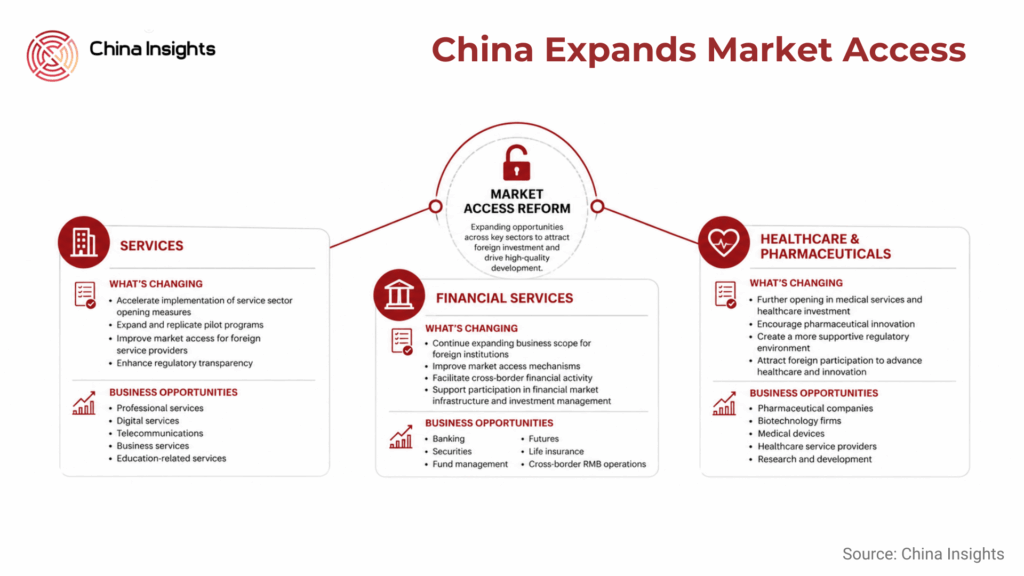
The service sector remains a major focus of China’s opening-up strategy. Policymakers increasingly view services as an important source of economic growth, employment, innovation, and consumer demand.
Authorities plan to accelerate the implementation of service sector opening measures and expand pilot programs that test new liberalization initiatives. This includes efforts to improve market access conditions for foreign service providers and enhance regulatory transparency.
China has already introduced a number of reforms in recent years through service sector opening-up pilot programs in selected cities and regions. The latest policy direction suggests that successful pilot measures may be expanded more broadly across the country. This could create additional opportunities in professional services, digital services, telecommunications, healthcare, education-related services, and business services.
Further Liberalization of Financial Services
Financial sector opening remains a priority area within China’s foreign investment agenda.
Over the past several years, China has removed foreign ownership caps in banking, securities, fund management, futures, and life insurance businesses. The latest policy initiatives focus less on ownership restrictions and more on expanding business opportunities, improving market access mechanisms, and facilitating cross-border financial activity.
According to the policy interpretation, authorities will continue to support foreign financial institutions seeking to participate in China’s financial markets. The objective is to increase market competition, improve financial services, and attract international capital and expertise.
Recent policy initiatives have also supported cross-border RMB operations, participation in financial market infrastructure, and broader access to investment management activities. These measures are intended to strengthen China’s position as an international financial market while supporting domestic economic development.
Increased Opening in Healthcare and Pharmaceuticals
Healthcare and pharmaceuticals have emerged as important sectors in China’s market access reforms.
The policy interpretation highlights further opening measures aimed at attracting foreign participation in medical services, pharmaceutical innovation, and healthcare-related investment. Authorities view international investment as a means of supporting technological advancement, improving healthcare services, and strengthening domestic innovation capabilities.
China’s healthcare market continues to expand due to demographic changes, rising healthcare expenditure, and increasing demand for advanced medical treatments. Foreign pharmaceutical companies, medical device manufacturers, healthcare service providers, and research organizations may benefit from a more supportive regulatory environment.
The pharmaceutical industry is also increasingly linked to broader national objectives related to innovation, biotechnology development, and healthcare modernization. As a result, policymakers are seeking to balance market opening with industrial development goals.
Market Access Reform as Part of a Broader Economic Strategy
The latest opening measures should be viewed within the context of China’s wider market reform agenda.
In August 2024, the General Office of the Communist Party Central Committee and the General Office of the State Council issued the Opinions on Improving the Market Access System (《关于完善市场准入制度的意见》). The document established a framework for creating a more transparent, standardized, and competitive market access system. It emphasized reducing market barriers, improving regulatory consistency, and enhancing competition across sectors.
The 2026 foreign investment measures complement these objectives by targeting sectors where foreign participation can contribute to economic modernization and service sector development.
Policymakers increasingly view market access reform as a tool for improving resource allocation, stimulating innovation, and enhancing productivity growth.
Implications for Foreign Investors
The latest policy direction suggests that China remains committed to attracting foreign investment despite a challenging global investment environment.
For multinational companies, the reforms may create new opportunities in sectors that have historically been subject to significant regulatory barriers. Service providers, financial institutions, pharmaceutical companies, biotechnology firms, and healthcare operators are among the sectors likely to benefit most directly.
However, market access expansion does not eliminate regulatory oversight. Foreign investors will continue to operate within sector-specific regulatory frameworks, national security review mechanisms, cybersecurity requirements, and competition regulations.
Companies evaluating market entry or expansion strategies should therefore continue to monitor policy developments closely and assess both opportunities and compliance requirements.
Outlook
China’s decision to further expand market access in services, financial services, and healthcare-related industries reflects a broader effort to strengthen economic competitiveness and improve the investment environment.
The policy signals continuity rather than a fundamental shift in direction. Authorities are building upon existing opening-up measures while seeking to accelerate implementation and improve policy effectiveness.
If fully implemented, the reforms could enhance foreign participation in key sectors, support domestic economic upgrading, and contribute to China’s objective of maintaining its position as a major destination for global investment.
What This Means for Business
The latest market access measures indicate that services, financial services, healthcare, and pharmaceuticals will remain priority sectors for foreign investment policy in the coming years.
Companies operating in these industries should closely monitor the implementation of new opening measures and assess whether pilot programs, licensing reforms, or market access changes create new commercial opportunities. Businesses already operating in China may also identify opportunities for expansion into activities that were previously restricted or subject to limited access.
While regulatory compliance remains essential, the overall policy direction suggests continued efforts to improve market access conditions and attract foreign participation in strategically important sectors.