
Background of the Existing Regulatory Framework
The current regulatory framework is based on the Provisions on the Merger and Acquisition of Domestic Enterprises by Foreign Investors (《关于外国投资者并购境内企业的规定》), jointly issued on 8 August 2006 by the Ministry of Commerce (MOFCOM), the State-owned Assets Supervision and Administration Commission (SASAC), the State Taxation Administration, the former State Administration for Industry and Commerce, the China Securities Regulatory Commission (CSRC), and the State Administration of Foreign Exchange (SAFE). The regulation entered into force on 8 September 2006 and was revised by the Ministry of Commerce on 22 June 2009.
The regulation established the legal framework for foreign investors acquiring equity interests in Chinese enterprises, subscribing to capital increases, or purchasing assets of domestic companies. It also introduced approval procedures, valuation requirements, anti-monopoly review provisions, and special rules governing cross-border share-swap transactions.
At the time of its introduction, the regulation represented a significant step in standardizing foreign investment M&A transactions. However, China’s foreign investment framework has undergone substantial changes since then.
Why Revision Is Considered Necessary
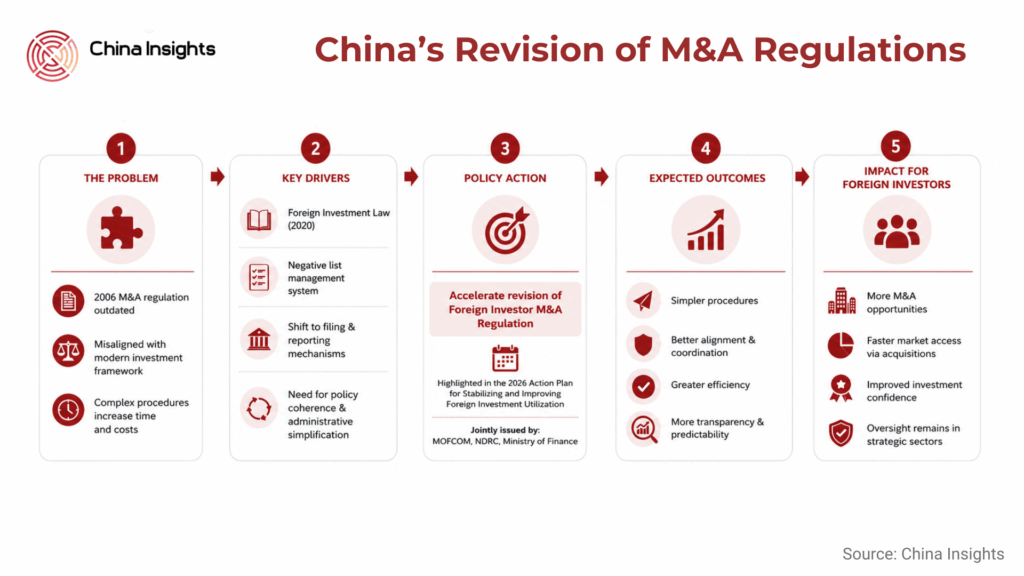
Chinese authorities indicate that the current regulation no longer fully reflects the country’s modern foreign investment governance framework.
Since the regulation was last amended in 2009, China has introduced several major reforms, including the implementation of the Foreign Investment Law in 2020, the adoption of the negative list management system for foreign investment, and the transition from approval-based administration toward filing and reporting mechanisms for many investment activities.
As a result, some provisions within the existing M&A regulation overlap with, or are no longer fully consistent with, newer legislation and administrative systems. Policymakers view regulatory modernization as necessary to reduce administrative burdens and improve policy coherence.
According to the State Council policy interpretation, accelerating the revision of the regulation is intended to further improve the foreign investment environment and support high-level opening-up.
Link to China’s Foreign Investment Strategy
The planned revision forms part of a broader policy agenda aimed at stabilizing foreign investment inflows and improving investor confidence.
In June 2026, the Ministry of Commerce, the National Development and Reform Commission (NDRC), and the Ministry of Finance jointly issued the Action Plan for Stabilizing and Improving Foreign Investment Utilization (《利用外资固稳促优行动方案》). The action plan identifies foreign investment as an important driver of economic development, technological upgrading, and industrial transformation.
Within this framework, authorities specifically highlighted the acceleration of revisions to the foreign investor M&A regulation as a priority measure to facilitate investment activities and enhance market access. The initiative reflects efforts to make foreign investment rules more transparent, predictable, and aligned with international business practices.
Potential Areas of Reform
Although detailed draft revisions have not yet been released, the policy direction provides indications regarding likely areas of focus.
One expected objective is better alignment with the Foreign Investment Law and the negative list management system. This could involve removing outdated approval requirements and clarifying regulatory procedures applicable to foreign acquisitions.
Another likely focus is improving transaction efficiency. Foreign investors have historically faced complex approval and documentation requirements when acquiring Chinese companies. Streamlining these procedures could reduce transaction costs and improve execution timelines.
Authorities may also seek to clarify the interaction between foreign investment review procedures, anti-monopoly reviews, national security reviews, and sector-specific regulations. Greater coordination among these regulatory frameworks could improve certainty for investors pursuing acquisition opportunities in China.
At the same time, national security considerations are expected to remain an important component of China’s foreign investment review framework, particularly in sectors involving critical technologies, infrastructure, data, energy, and strategic resources.
Implications for Foreign Investors
The revision could create additional opportunities for multinational corporations seeking growth through acquisitions rather than greenfield investments.
M&A transactions often provide faster market access, established customer relationships, existing distribution networks, and operational capabilities. A more streamlined regulatory framework could therefore increase the attractiveness of acquisition-led investment strategies in China.
The reform may be particularly relevant for companies operating in advanced manufacturing, healthcare, consumer goods, industrial technology, renewable energy, and modern services sectors, where consolidation and strategic partnerships continue to play an important role.
However, investors should not expect a complete removal of regulatory oversight. China continues to emphasize national security, fair competition, and industrial policy objectives when reviewing foreign investment transactions. Regulatory compliance and transaction planning will therefore remain critical elements of successful acquisitions.
Outlook
The decision to accelerate revisions to the foreign investor M&A regulation reflects China’s broader effort to modernize its foreign investment regime and maintain its competitiveness as a destination for global capital.
The existing regulation has remained largely unchanged for more than fifteen years despite significant reforms to China’s investment governance framework. Updating the rules would help align the M&A regime with current foreign investment policies and potentially improve the efficiency of cross-border transactions.
While the scope of the revisions remains under development, the policy direction indicates continued support for foreign investment participation in China’s economy through acquisition and restructuring activities.
What This Means for Business
The planned revision signals continued efforts by Chinese authorities to improve the investment environment and facilitate foreign participation in the domestic economy.
Foreign investors should monitor the forthcoming draft revisions closely, particularly companies pursuing acquisition-led growth strategies in China. Regulatory modernization could create new opportunities for cross-border transactions while reducing administrative complexity.
At the same time, businesses should continue to assess national security review requirements, antitrust considerations, and sector-specific restrictions when evaluating acquisition targets.
Although transaction procedures may become more efficient, regulatory oversight of strategically important sectors is likely to remain robust.
For multinational companies seeking long-term growth in China, the revision represents a potentially important development in the evolution of the country’s foreign investment framework.