
China Upgrades Policy Framework for Comprehensive Bonded Zones
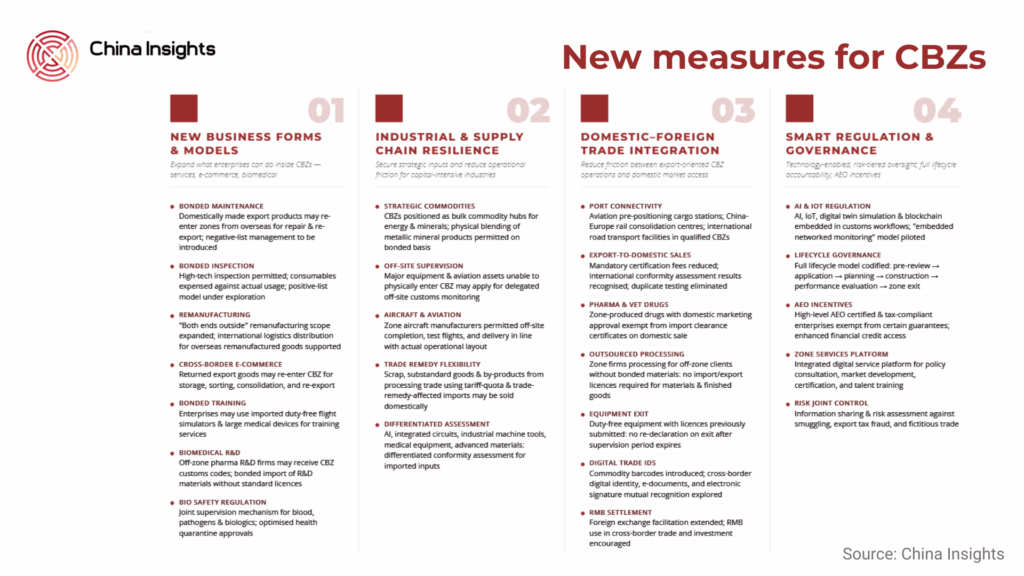
On 14 April 2026, China’s General Administration of Customs (GAC) issued the Several Measures on Promoting the Capacity Expansion and Quality Improvement of Comprehensive Bonded Zones (关于促进综合保税区扩能提质的若干措施). The policy represents the most comprehensive revision to the operational and regulatory framework of China’s comprehensive bonded zones (CBZs) in recent years, spanning 24 measures across four policy pillars.
For international businesses operating in or considering entry into China, this upgrade creates an expanded and more flexible operational environment. Collaborating early with zone administrators and local customs authorities is crucial for turning the national framework into practical operational strategies.
Executive Summary
- The new 24-measure package expands the number and types of permissible business activities within China’s comprehensive bonded zones.
- New provisions support bonded maintenance, bonded inspection, remanufacturing, cross-border e-commerce returns, and biomedical R&D co-development with off-zone entities.
- It introduces better support for industries that rely on large equipment or raw materials. Companies dealing with bulk commodities can now store and process these inside the zones more easily. Businesses that lease out aircraft or heavy machinery no longer need to physically move that equipment into the zone to benefit from customs oversight as inspectors can come to wherever the equipment actually is.
- Selling zone-made products in China has become easier through simplified certification for export-to-domestic-sale conversions and streamlined equipment exit procedures, and
- Smart regulation via AI, IoT, and blockchain will be used to monitor the zones more efficiently

Comprehensive Bonded Zones (CBZ)
Comprehensive bonded zones are customs-supervised territories that function as China’s most open and policy-rich special economic areas. They offer tax refunds upon entry, bonded import treatment, and relatively free movement of goods within their boundaries. These are mechanisms that collectively reduce institutional transaction costs for businesses operating within them.
As of April 2026, China operates 23 Free Trade Zones and an extensive network of CBZs that collectively processed roughly one-fifth of the country’s total foreign trade during the 2021–2025 planning period.
The policy update arrives at a moment when the broader Free Trade Zone ecosystem is also under active review. On 17 April 2026, the State Council’s executive meeting separately heard a work report on Free Trade Zone construction and directed a strategy of differentiated, location-specific development. This signals that Beijing intends a simultaneous upgrade of both the macro FTZ framework and the micro-level operational rules governing CBZs.
Expanding the Permitted Business Scope
The first pillar of measures broadens what companies are permitted to do inside CBZs.
- On bonded maintenance, enterprises will now be allowed to bring domestically manufactured export products, and their components, back into zones from overseas for repair before re-export. Enterprises can perform these activities without being bound by the existing maintenance product catalogue or the prohibited-import list for used electro mechanical goods.
- Authorities further signal intent to introduce a negative-list management model for bonded maintenance, and to progressively allow repaired goods to be sold into the domestic market subject to existing import regulations.
- Bonded inspection receives a parallel liberalization. Enterprises can conduct high-value, technology-intensive inspection activities on goods temporarily imported for testing, which entails consumable materials to be expensed against actual usage rather than pre-set quotas.
- Addressing a longstanding operational gap for merchants managing reverse logistics flows, cross-border e-commerce operators gain the right to return exported goods into a CBZ for consolidated storage, sorting, and re-export.
- The biomedical sector receives particularly targeted support. Off-zone pharmaceutical R&D companies that meet defined conditions may be granted a CBZ customs registration code, which enables them to import R&D materials on a bonded basis without the usual licensing requirements, subject to actual R&D consumption verification. This arrangement effectively extends CBZ policy privileges to select off-zone entities.
Strengthening Industrial and Supply Chain Resilience
The second pillar of measures addresses supply chain security in line with China’s broader strategic priorities.
- CBZs are explicitly positioned to support the construction of bulk commodity storage and distribution hubs for energy and mineral resources. Zone enterprises are permitted to conduct physical blending of metallic mineral products on a bonded logistics basis.
- For major technical equipment, the measures introduce off-site customs supervision. The new measure targets in particular aircraft, aviation engines, and capital goods used in finance leasing.
- Where physical entry into a CBZ is genuinely impractical, enterprises may apply for delegated monitoring arrangements. This would reduce logistics costs while maintaining customs oversight. A differentiated conformity assessment framework is also introduced for enterprises developing critical technologies such as artificial intelligence, integrated circuits, industrial machine tools, and advanced materials.

Integrating Domestic and Foreign Trade Flows
The third pillar targets friction between export-oriented CBZ operations and domestic market access.
- Export products subject to mandatory certification can now reach domestic consumers more easily when manufacturers choose to redirect them from export to local sale. Under the new measures, authorities will reduce certification fees and simplify the approval process.
- Manufacturers can also present internationally recognized conformity assessment results, eliminating the need to repeat testing that has already been conducted abroad. Companies serving both export and domestic markets stand to benefit most from this change.
- Pharmaceutical and veterinary drug manufacturers operating inside bonded zones no longer need to obtain import drug clearance certificates when selling their products domestically, provided those products already carry domestic marketing approval. This removes a longstanding procedural inconsistency where goods destined for the Chinese market were treated as imports despite being produced domestically.
- On financial flows, the new measures push further towards opening up trade and investment foreign exchange. Authorities are actively encouraging companies to settle cross-border transactions in renminbi rather than foreign currencies.
Modernising Regulatory Architecture
The fourth pillar of measures formalizes the shift toward technology-enabled, risk-tiered regulation.
- Aiming to produce intelligent, differentiated, and precise oversight calibrated to individual enterprise risk profiles rather than uniform process requirements, the GAC will embed AI, IoT, digital twin simulation, and blockchain across customs supervision workflows.
- A full lifecycle governance model is codified for CBZs, encompassing pre-establishment review, application, planning revision, construction acceptance, performance evaluation, and zone exit. Enterprises holding high-level AEO (Authorized Economic Operator) certification and high tax-compliance ratings receive expanded benefits, including exemption from certain guaranteed requirements and enhanced access to financial credit.
- On governance, the measures codify a full lifecycle model for CBZs. This model covers every stage of a zone’s existence, from pre-establishment review and application through planning, construction, and performance evaluation, to eventual zone exit where applicable.
- High-compliance enterprises stand to gain the most from the new framework. Companies holding high-level AEO (Authorized Economic Operator) certification or strong tax compliance ratings will receive expanded benefits. These include exemption from certain financial guaranteed requirements and improved access to credit facilities.
What This Means for Business
Foreign and domestic enterprises operating in or considering entry into China’s comprehensive bonded zones face an expanded and more flexible operational environment.
- The removal of catalogue restrictions on bonded maintenance and inspection opens new service revenue streams for manufacturers with global after-sales networks, particularly those in advanced manufacturing, aerospace, and medical technology.
- The off-site customs supervision mechanism for major equipment and aviation assets reduces practical barriers to structuring finance leasing arrangements through CBZ entities. Businesses in aircraft leasing and heavy capital equipment financing should review whether existing structures can be optimized under the new rules.
- For biomedical and pharmaceutical companies, the ability to extend CBZ registration codes to off-zone R&D facilities is a meaningful operational gain, enabling bonded importation of research materials without full zone presence. Companies with China R&D operations should assess eligibility criteria as implementation guidance is issued by local customs authorities.
- More broadly, the policy signals continued regulatory investment in CBZs as a primary vehicle for China’s manufacturing and trade policy objectives. Enterprises with significant China supply chain exposure should monitor the rollout of implementing rules at the provincial and zone level, as the measures explicitly call for differentiated, location-specific execution strategies.
Early engagement with zone administrators and local customs offices will be important for translating the national framework into actionable operational plans.
Sources
https://www.gov.cn/zhengce/content/2026-04/17/content_7027637.htm
https://www.gov.cn/yaowen/liebiao/202604/content_7027608.htm
Author
Dr. Richard van Ostende

Related Articles