
China Launches Multi-Ministry Initiative to Support Small Businesses: 50 Measures to Strengthen Market Vitality
On 24 March 2026 China’s State Taxation Administration in cooperation with six other departments released the Notice on Launching the 2025 “Spring Rain Nourishing Seedlings” Special Action to Support Small and Micro Business Entities 税总办纳服发〔2025〕23号aimed at addressing structural challenges faced by small business operators.
The initiative reflects a broader policy direction: shifting from short-term relief toward more coordinated, systemic support mechanisms that integrate tax policy, financing, compliance, and industrial upgrading.
For international businesses operating in China, the government’s Notice signals a more coordinated but also more closely monitored policy environment. Making strong regulatory alignment and a solid compliance record increasingly important for accessing incentives. Companies that understand how to navigate China’s evolving credit and compliance systems, and that explore strategic partnerships within the small business ecosystem, will be better positioned to benefit as policy support strengthens across the full business lifecycle.
Executive Summary
- China’s tax authority and multiple ministries launched a coordinated support initiative for small and micro businesses
- The policy emphasizes tax incentives, financing access, and supply chain integration
- Measures are structured around improving service delivery, resolving operational challenges, and enabling business upgrading
- A lifecycle-based support framework is introduced to assist firms from startup to scaling
- The initiative reinforces the role of data-driven governance and inter-agency coordination

Policy Structure and Strategic Focus
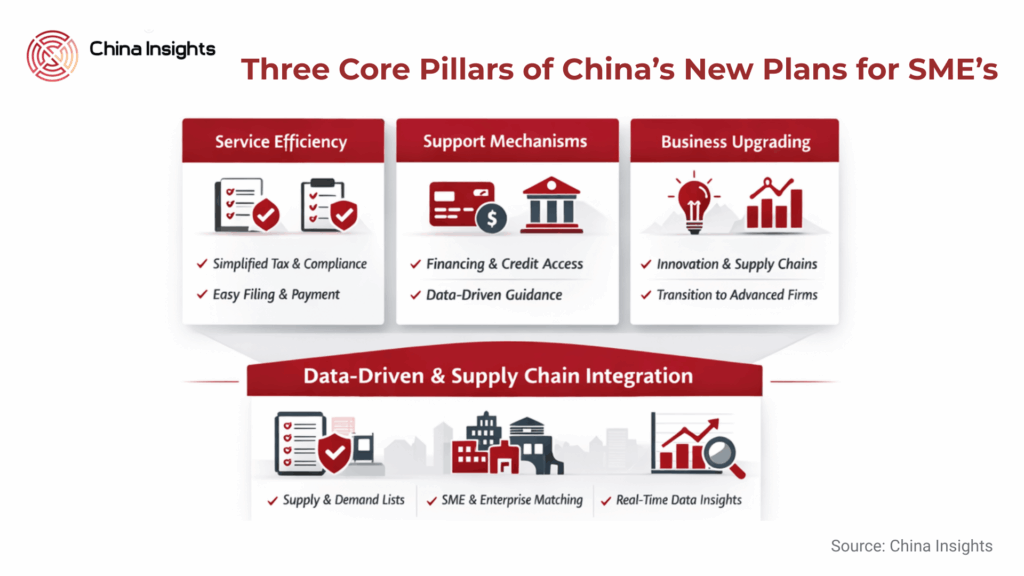
The initiative is structured around three core pillars: improving service efficiency, strengthening support mechanisms, and enabling business upgrading.
First, authorities aim to enhance administrative efficiency by simplifying tax and compliance procedures. This includes improving policy communication, increasing the precision of support delivery, and enhancing the convenience of tax filing and payment processes. The focus is on reducing administrative burdens while increasing policy accessibility.
Second, the initiative strengthens factor support, particularly in financing and credit access. By leveraging tax data and credit evaluation systems, authorities aim to guide financial institutions toward better serving small and micro enterprises. This reflects a growing reliance on data-driven governance tools to reduce information asymmetry and improve capital allocation.
Third, the policy promotes industrial upgrading by supporting innovation, encouraging participation in supply chains, and facilitating the transition of high-potential firms into more advanced business categories. This includes targeted support for key industries and emerging sectors.
The Role of Data and Supply Chain Integration
A notable feature of the initiative is the use of tax data to support industrial linkages. Authorities plan to create “supply and demand lists” and “recommendation lists” based on enterprise data, enabling more efficient matching between small firms and larger enterprises. This approach aims to address a long-standing structural issue: the limited integration of small businesses into broader industrial ecosystems. By improving connectivity within supply chains, policymakers seek to enhance resilience and competitiveness across sectors. The use of real-time data also supports more targeted policymaking, allowing authorities to identify bottlenecks and respond more dynamically to business needs.
Lifecycle-Based Support Mechanisms
Another key development is the introduction of a “full lifecycle” service model for small and micro enterprises. This model provides differentiated support at various stages of business development, from startup to expansion. For newly established firms, the focus is on facilitating market entry through simplified procedures and targeted policy guidance. For growing enterprises, support shifts toward financing, compliance, and operational efficiency. More mature firms receive assistance in upgrading, innovation, and scaling. This lifecycle approach reflects a more nuanced understanding of the heterogeneous needs within the small business sector and aims to improve policy effectiveness.
Compliance and Risk Management
The initiative also places strong emphasis on improving compliance and risk awareness among small businesses. Authorities plan to provide targeted guidance on regulatory requirements and increase transparency regarding enforcement practices. This includes the promotion of tax compliance systems and the introduction of credit-based incentives to encourage lawful business conduct. At the same time, enforcement actions are expected to become more standardized, reducing uncertainty for businesses. By strengthening compliance frameworks, policymakers aim to create a more predictable and fair business environment.

Support for Structural Transformation
In addition to short-term relief, the policy seeks to support longer-term structural transformation. This includes encouraging digitalization, promoting green development, and facilitating the transition from individual businesses to corporate entities. Authorities are also introducing differentiated support mechanisms based on business type, categorizing firms into “survival,” “growth,” and “development” stages. This allows for more targeted interventions and better allocation of policy resources. Such measures align with China’s broader economic strategy of fostering high-quality growth and upgrading industrial capabilities.
What this Means for Business
For businesses operating in or engaging with China, this policy initiative signals several important trends.
- The increasing role of inter-agency coordination suggests that support measures will become more integrated and comprehensive. Companies should expect more streamlined processes but also more data-driven oversight.
- The emphasis on compliance and credit systems highlights the importance of maintaining strong regulatory alignment. Firms with robust compliance practices are likely to benefit more from policy incentives.
- The focus on supply chain integration presents opportunities for both domestic and foreign companies to engage with China’s small business ecosystem. Partnerships with qualified small enterprises may become more attractive as policy support strengthens their capabilities.
- The shift toward lifecycle-based support indicates that policy engagement strategies should be tailored to the specific stage of business development. Understanding where a company fits within this framework will be critical for maximizing policy benefits.
Sources
- State Taxation Administration:
http://fgk.chinatax.gov.cn/zcfgk/c102424/c5239297/content.html - Chinese Government Website (Policy Overview):
https://www.gov.cn/zhengce/zhengceku/202306/content_6884277.htm - Official Policy Notice (2025 Action):
https://shanxi.chinatax.gov.cn/zdgk/detail/sx-11400-545-1806816
Author
Dr. Richard van Ostende

Related Articles