
China’s Low-Altitude Economy Enters Standardization Phase with 2030 Roadmap
China is accelerating the institutionalization of its low-altitude economy, a sector encompassing drones, urban air mobility, and supporting infrastructure. A recent policy interpretation and Q&A released on the official Chinese government website outlines a coordinated initiative by ten central government departments to establish a comprehensive standards system by 2030. The policy signals a shift from pilot-based experimentation toward a rules-based, scalable development model.
For international businesses operating in China, this push signals a maturing regulatory environment: One that promises greater clarity for companies in drone technology and urban air mobility, while raising the stakes for early compliance. Those who engage proactively with China’s evolving framework, and where possible its standard-setting processes, will be best positioned to compete in what Beijing is clearly positioning as a strategically important, high-growth sector.
Executive Summary
- Ten Chinese government departments jointly issued a policy interpretation targeting the development of the low-altitude economy
- The initiative aims to establish more than 300 technical and regulatory standards by 2030
- The policy emphasizes standardization as a key mechanism to accelerate commercialization and industrialization
- Focus areas include infrastructure, airspace management, safety, and industrial applications
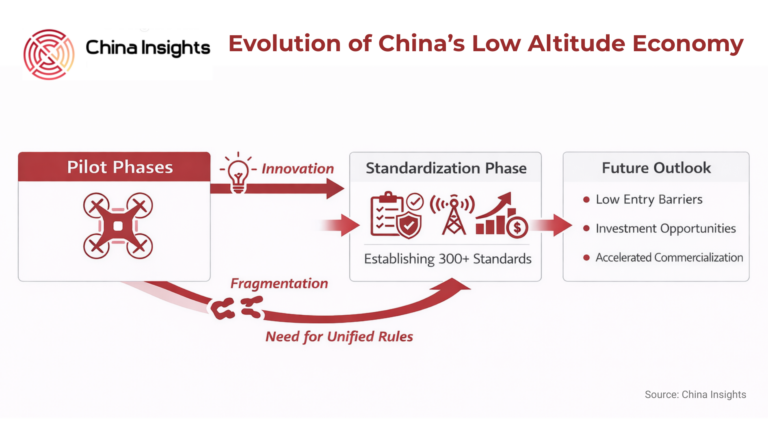
- The framework reflects a transition from fragmented pilots to coordinated national-level governance
- The initiative is expected to support broader adoption of drones and urban air mobility solutions across sectors

Policy Background and Institutional Context
The policy interpretation titled “Ten departments proposed that by 2030, more than 300 relevant standards will be established to accelerate the ‘establishment of rules’ in the low-altitude economy” was published on the official Chinese government portal. It reflects a joint effort by ten central authorities, although the document does not always explicitly list all participating agencies in summary releases. Typically, such cross-ministerial initiatives involve bodies such as the Civil Aviation Administration of China (CAAC), the Ministry of Industry and Information Technology (MIIT), and other regulators responsible for airspace, technology standards, and industrial policy.
The release date of the policy interpretation corresponds with China’s broader push to formalize emerging industries through structured regulatory frameworks. In this case, the low-altitude economy, long characterized by pilot zones and local experimentation, is entering a phase of national-level coordination.
From Pilot Programs to Standardized Development
China’s low-altitude economy has developed rapidly in recent years, driven by advances in drone technology, logistics applications, and urban air mobility concepts. However, growth has largely been supported by localized pilot programs and regulatory sandboxes. While effective in fostering innovation, this approach has also resulted in fragmentation across regions and use cases.
The current policy initiative addresses this challenge by prioritizing standardization. The target of more than 300 standards by 2030 suggests a comprehensive framework covering technical specifications, operational procedures, and safety requirements. This shift indicates that policymakers are seeking to reduce uncertainty, improve interoperability, and enable cross-regional scalability.
Standardization is positioned not only as a regulatory tool but also as a strategic enabler of industrial growth. By defining clear rules, authorities aim to lower barriers to entry, facilitate investment, and accelerate commercialization.
Key Areas of Standard Development
The policy outlines several priority areas for the development of standards, reflecting the complexity of the low-altitude economy ecosystem.
Infrastructure development is a central focus. This includes standards for vertiports, drone logistics hubs, and supporting communication networks. As low-altitude operations expand, the need for interoperable and scalable infrastructure becomes increasingly critical.
Airspace management is a key regulatory challenge. The integration of drones and other low-altitude vehicles into existing airspace requires new frameworks for traffic management, route planning, and coordination with traditional aviation systems. Standardization in this area is essential to ensure safe and efficient operations.
Safety and risk management are emphasized. This includes standards for vehicle design, maintenance, and operational protocols, as well as emergency response mechanisms. Given the potential risks associated with low-altitude operations in urban environments, safety remains a top priority for regulators.
The policy highlights industrial applications. These include logistics, agriculture, emergency response, and urban mobility. By developing standards tailored to specific use cases, authorities aim to support the commercialization of low-altitude technologies across multiple sectors.
Strategic Implications for Industrial Policy
The initiative aligns with China’s broader industrial policy objectives, particularly in emerging technology sectors. The low-altitude economy is increasingly seen as a strategic industry with the potential to drive innovation, create new business models, and enhance economic efficiency.
By emphasizing standardization, the government is adopting a familiar approach used in other sectors such as electric vehicles and telecommunications. Establishing a comprehensive standards system can help domestic companies scale more effectively while also shaping global norms.
Moreover, the involvement of multiple government departments underscores the cross-sectoral nature of the low-altitude economy. Coordination across regulators is essential to address overlapping issues related to airspace, technology, and industrial development.

Challenges and Implementation Considerations
Despite the clear policy direction, implementation will present challenges. Developing more than 300 standards within a relatively short timeframe requires significant coordination among stakeholders, including government agencies, industry players, and standardization bodies.
Another challenge is balancing standardization with innovation. While clear rules can facilitate growth, overly rigid standards may limit flexibility and slow technological advancement. Policymakers will need to ensure that the framework remains adaptable to evolving technologies.
In addition, regional disparities may persist. While national standards can provide a unified framework, local governments will continue to play a key role in implementation. Aligning local initiatives with national objectives will be critical to achieving consistent outcomes.
What This Means for Business
The policy signals a maturing regulatory environment for the low-altitude economy in China. For businesses, this creates both opportunities and challenges.
Companies operating in drone technology, urban air mobility, and related sectors can expect greater regulatory clarity in the coming years. This is likely to reduce uncertainty and support long-term investment decisions. Standardization may also facilitate market entry by lowering compliance complexity and enabling interoperability across regions.
At the same time, businesses will need to closely monitor the development of specific standards. Early alignment with emerging requirements can provide a competitive advantage, particularly in areas such as safety, infrastructure, and airspace integration.
For foreign companies, the initiative highlights the importance of understanding China’s regulatory approach to emerging industries. Participation in standard-setting processes—where possible—may be critical to ensuring compatibility with global operations.
Overall, the move toward a comprehensive standards system indicates that China is positioning the low-altitude economy as a scalable and strategically important sector. Businesses that adapt early to this evolving framework will be better positioned to capture opportunities as the market develops.
Sources
Chinese Government Website – Policy Interpretation and Q&A: “Ten departments proposed that by 2030, more than 300 relevant standards will be established to accelerate the ‘establishment of rules’ in the low-altitude economy” https://www.gov.cn/zhengce/202603/content_7063521.htm
Author
Dr. Richard van Ostende

Related Articles