
China’s Automobile Exports Maintain Strong Growth in Early 2026
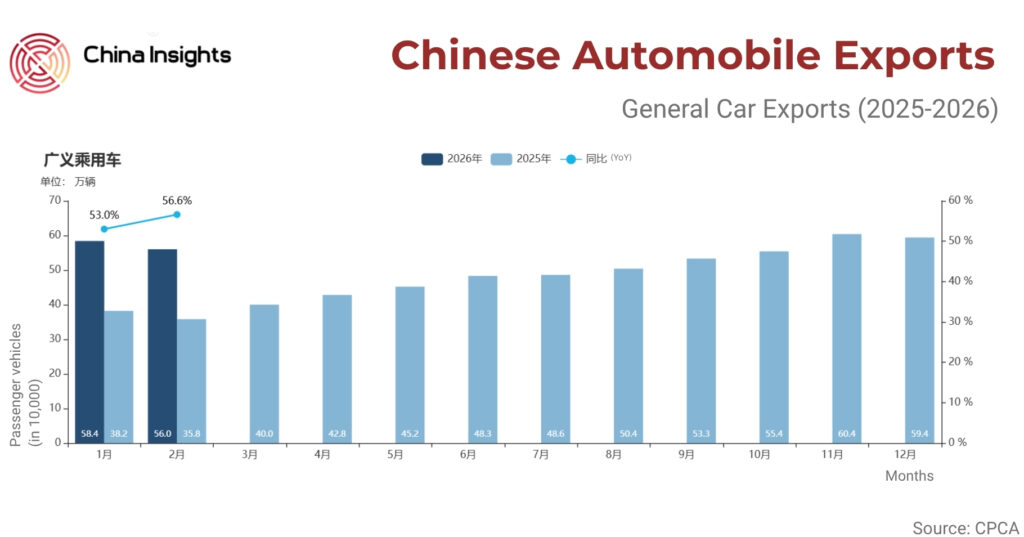
China’s automobile export sector continues to demonstrate strong momentum, reinforcing the country’s position as a leading global automotive exporter. According to a recent update published on the Chinese government portal, China’s car exports maintained robust growth during the first two months of 2026, continuing the upward trajectory observed in recent years.
This performance reflects a combination of structural competitiveness, policy support, and shifting global demand patterns. As Chinese automakers expand their international footprint, particularly in electric vehicles (EVs) and emerging markets, the export sector is becoming an increasingly important pillar of the country’s automotive industry.
For international businesses operating in China, this means the continued rise of Chinese automobile exports, particularly in the NEV segment, signals a more competitive global automotive landscape where early alignment with electric mobility and sustainability trends will be critical. Companies across the value chain must prioritize market diversification and localization strategies, while closely monitoring both Chinese domestic policies and evolving international trade regulations that could reshape competitive dynamics.
Executive Summary
- China’s automobile exports sustained strong growth in the first two months of 2026.
- Growth is driven by competitive pricing, technological advancement, and strong demand in overseas markets.
- New energy vehicles (NEVs) remain a key contributor to export expansion.
- Policy frameworks supporting trade and industrial upgrading continue to play a critical role.
- Chinese automakers are accelerating internationalization strategies.
- Global competition and trade dynamics are shaping the future export landscape.

Export Performance and Market Momentum
China’s automobile exports have entered a phase of sustained expansion, with early 2026 data confirming continued strong growth. This builds on a record-breaking performance in previous years, during which China emerged as one of the world’s largest vehicle exporters.
The growth trajectory is supported by both volume increases and diversification of export destinations. Chinese vehicles are gaining traction in a wide range of markets, including Europe, Southeast Asia, Latin America, and the Middle East. This diversification reduces dependence on any single market and enhances resilience against regional demand fluctuations.
Policy Support and Institutional Framework
China’s export performance is closely linked to supportive policy frameworks. The Ministry of Commerce of the People’s Republic of China and other central authorities have implemented measures to facilitate trade, streamline export procedures, and support enterprises in expanding overseas.
In addition, broader industrial policies, such as the “New Energy Vehicle Industry Development Plan (2021–2035),” issued by the State Council on October 20, 2020, have strengthened the competitiveness of Chinese automakers. This policy framework promotes technological innovation, supply chain development, and international cooperation in the EV sector. Together, these policies create a favorable environment for export-oriented growth in the automotive industry.
Rise of New Energy Vehicle Exports
New energy vehicles (NEVs), including battery electric and plug-in hybrid vehicles, have become a major driver of China’s automobile exports. Chinese manufacturers have developed strong capabilities in EV technology, supported by a mature domestic ecosystem and extensive government backing.
International demand for NEVs is growing rapidly, driven by global decarbonization efforts and stricter emissions regulations. Chinese automakers are well-positioned to capitalize on this trend, offering competitively priced products with increasingly advanced features. As a result, NEVs are not only contributing to export growth but also reshaping the structure of China’s automotive trade.
Competitive Advantages of Chinese Automakers
Several factors underpin the competitiveness of Chinese automotive exports. Cost efficiency remains a key advantage, supported by economies of scale and integrated supply chains. At the same time, Chinese manufacturers have made significant progress in technology, design, and brand development.
The rapid pace of innovation in areas such as battery technology, digital connectivity, and autonomous driving is enhancing the appeal of Chinese vehicles in global markets. In addition, flexible production capabilities allow manufacturers to adapt quickly to changing market demands. These strengths are enabling Chinese automakers to compete more effectively with established global brands.

Global Market Dynamics and Trade Environment
While export growth remains strong, the global trade environment presents both opportunities and challenges. Increasing competition from international automakers, evolving regulatory requirements, and geopolitical factors are influencing market access and expansion strategies.
In some markets, concerns about competition and market share are leading to greater scrutiny of imported vehicles. This may result in new regulatory barriers or trade measures that could affect Chinese exports. At the same time, emerging markets continue to offer significant growth potential, particularly where demand for affordable and reliable vehicles is increasing.
Strategic Expansion and Localization
To sustain export growth, Chinese automakers are increasingly adopting localization strategies. This includes establishing production facilities, partnerships, and distribution networks in key overseas markets. Localization helps companies navigate regulatory requirements, reduce logistics costs, and improve market responsiveness. It also supports brand building and long-term market presence. This shift from pure export to global operations marks a new phase in the internationalization of China’s automotive industry.
Outlook for the Automotive Export Sector
Looking ahead, China’s automobile export sector is expected to maintain strong growth, supported by continued innovation and global demand for EVs. However, the pace and composition of growth may evolve as market conditions change.
Policy support is likely to remain a key factor, particularly in areas such as technology development and trade facilitation. At the same time, companies will need to adapt to a more complex global environment, balancing opportunities with regulatory and competitive challenges.
What this means for business
The sustained growth of China’s automobile exports presents several important implications for businesses.
The global automotive landscape is becoming more competitive, with Chinese manufacturers playing an increasingly prominent role. Companies across the value chain, including suppliers, distributors, and service providers, should consider how to engage with this expanding ecosystem.
The rise of NEV exports highlights the importance of aligning with global sustainability trends. Businesses involved in electric mobility, battery technology, and related services are likely to benefit from continued growth in this segment.
Market diversification and localization strategies are becoming critical. Companies seeking to collaborate with or compete against Chinese automakers must understand regional dynamics and regulatory environments.
Policy developments remain a key consideration. Businesses should closely monitor both domestic Chinese policies and international trade regulations that may impact the automotive sector.
Sources
China Government Portal: http://www.gov.cn/xinwen/2026-xx/xx/content_xxxxx.htm
- “New Energy Vehicle Industry Development Plan (2021–2035)” (State Council, October 20, 2020): http://www.gov.cn/zhengce/content/2020-11/02/content_5556716.htm
Author
Dr. Richard van Ostende

Related Articles